
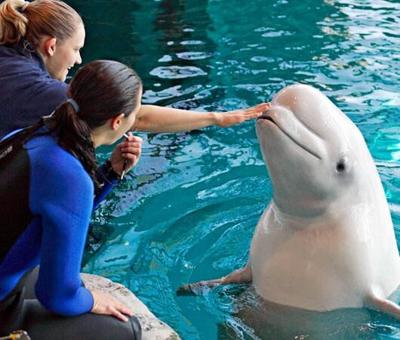

There is finally some good news in the heartbreaking story of Shedd Aquarium’s rescued belugas. Sierra, one of the 10 belugas brought to Chicago from the shuttered Marineland of Canada, is beginning to trust her new caregivers. The 26-year-old female has learned that touch is an important way to communicate with her Shedd team, a breakthrough that recently allowed her to voluntarily participate in medical care.
Subscribe to Chicago Star’s Weekly City Buzz Newsletter
For the first time at Shedd, Sierra presented her flukes for a blood draw and cooperated with an eye examination. Caregivers believe she has some recent visual impairment, particularly on her right side, but her willingness to participate is an encouraging sign.
She is also becoming more engaged with the other rescued belugas.
Secord is showing progress, too, eating more consistently. That's especially important for belugas, which obtain much of their water through their food.
You may like these Chicago Star articles:
• Cheers to 30 years! Christkindlmarket debuts 2026 collectible collection
• Donnie Wahlberg and Jenny McCarthy’s St. Charles estate hits market for $2.8 million
• More fall fun! Apple picking, hayrides and a pumpkin-eating dinosaur
The good news comes as Shedd's veterinary team works to understand the heartbreaking deaths of four belugas since the rescue began.
New preliminary necropsy findings are providing important clues about two of the rescued whales, Peekachu and Rain. Both had significant chronic gastrointestinal disease, with severe inflammation in their digestive systems.
Shedd says the findings suggest the disease had likely been present for months or even years before the whales arrived in Chicago, meaning they came to Shedd with serious underlying health problems.
The aquarium has not identified one definitive cause of death, and additional testing is continuing. But the discovery of longstanding gastrointestinal disease is an important piece of the puzzle.
Peekachu, 23, died Aug. 25, only weeks after arriving in Chicago. Rain, 20, died in early September.
Beethoven, a 34-year-old longtime Shedd resident, also died. His examination showed several changes associated with aging, including cardiovascular changes.
Then came the death of Osiris, a 26-year-old female rescued from Marineland, who died Sept. 21. Shedd is conducting a separate examination of Osiris and has cautioned against assuming that the findings from Peekachu and Rain explain her death.
Peekachu's examination revealed another startling detail: bird feathers, sticks and large, porous rocks in her stomach. Shedd believes the material was ingested before her arrival in Chicago. Small flecks of material that may have been paint were also found in Rain's stomach.
Shedd does not believe the foreign material directly caused either death, but the findings offer another glimpse into the whales' health before the rescue.
Importantly, testing so far has found no evidence of a shared infectious disease or common environmental factor connecting the deaths of Peekachu, Rain and Beethoven. Additional testing for bacterial, fungal and viral pathogens continues.
The emerging picture is not necessarily one of a single illness spreading among the belugas. Instead, some of the rescued whales appear to have arrived with complicated, longstanding medical histories that Shedd is only now beginning to understand.
The 10 belugas came to Chicago after Marineland closed and could no longer provide long-term care for its remaining whales. The first four arrived July 21, four more followed in August and the final two, Yukon and Gimli, arrived Sept. 1.
Getting them to Chicago was only the beginning.
Now Shedd's focus is on helping each whale adjust, identifying individual medical needs and building trust so caregivers can safely monitor and treat them.
That trust is particularly important with animals this large. Shedd trains its belugas to voluntarily participate in medical procedures whenever possible, making Sierra's recent blood draw and eye examination especially meaningful.
The situation remains concerning. Shedd continues to monitor the surviving rescued whales around the clock, with Caspian and Secord among those receiving particular clinical attention.
There is also hope that Yukon and Gimli will eventually reconnect with their mothers, Acadia and Secord. No timetable has been set; Shedd is allowing the whales' behavior and comfort level to guide those introductions.
For now, every positive development matters. A whale eating. A whale exploring. A whale becoming comfortable with a caregiver. A whale voluntarily presenting a fluke for a blood draw.
After four heartbreaking losses, those aren't small victories.
For Sierra and the six other rescued belugas who remain, they are signs that trust is beginning to replace uncertainty.
And for now, that is very good news.




(0) comments
Welcome to the discussion.
Log In
Keep it Clean. Please avoid obscene, vulgar, lewd, racist or sexually-oriented language.
PLEASE TURN OFF YOUR CAPS LOCK.
Don't Threaten. Threats of harming another person will not be tolerated.
Be Truthful. Don't knowingly lie about anyone or anything.
Be Nice. No racism, sexism or any sort of -ism that is degrading to another person.
Be Proactive. Use the 'Report' link on each comment to let us know of abusive posts.
Share with Us. We'd love to hear eyewitness accounts, the history behind an article.