

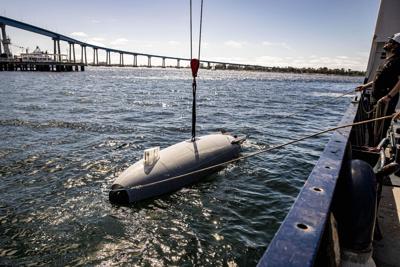


The Anduril Dive-LD, the U.S. autonomous underwater vehicle that Iran says it captured near the Strait of Hormuz. The U.S. Navy says the vehicle was an older model that had malfunctioned.
U.S. Navy photo by Loren Nichols/DVIDS/ Public Domain)
Iran may have scored more than a propaganda victory after claiming it captured a sophisticated U.S. unmanned underwater vehicle near the Strait of Hormuz. The bigger concern for U.S. officials and defense experts is what Tehran might learn from the machine itself.
Iran's Islamic Revolutionary Guard Corps said Sept. 8 that its naval forces had seized an American underwater drone near the entrance to the strategic waterway. Iranian media subsequently released images of what appeared to be the captured vehicle.
Subscribe to Chicago Star’s Weekly City Buzz Newsletter
The system is identified as the Dive-LD, an autonomous underwater vehicle developed by Anduril Industries and used by the U.S. military. According to reporting by Reuters, the seizure gives Iran an opportunity to study the vehicle's hardware and potentially reverse-engineer portions of its technology.
More Chicago Star articles:
• Rapper Common set to headline Navy Pier’s Chicago Live!
• Arcada Theatre turns 100 with Chubby Checker, Priscilla Presley and a giant twist
• Celebrating Chicago Star Media with Mariano’s Lakeshore East
• Matt Suhey, the unsung hero of the ’85 Chicago Bears dies at 68
That doesn't necessarily mean Tehran has suddenly acquired a secret American weapon. U.S. officials have emphasized that the vehicle was an older system, had malfunctioned and did not contain classified payloads. Still, defense experts say even an unclassified platform can provide valuable information about how the United States designs, powers, navigates and operates autonomous underwater systems.
The Dive-LD is roughly 19 feet long and weighs about three tons. It is designed for underwater missions including reconnaissance, mine-related operations and detecting or tracking submarines. The vehicle can operate at extraordinary depths, making it a very different animal from the small aerial drones that have become familiar on modern battlefields as reported in the New York Post.
The reverse-engineering question
The concern is not necessarily that Iran will be able to simply copy the Dive-LD and produce an identical American system.
Instead, engineers could examine individual components and design choices, potentially learning from the vehicle's propulsion and power systems, navigation equipment, sensors, communications architecture and physical construction. Reuters reported that experts believe Iran could replicate some of the drone's mechanical systems, although encrypted software and other technological safeguards could make a complete copy much more difficult.
That distinction matters. Reverse engineering captured military equipment has long been a way for countries with fewer resources to accelerate their own weapons development. Iran has previously examined captured U.S. technology, including the RQ-170 Sentinel stealth drone that came down in Iran in 2011.
The underwater environment makes the issue particularly interesting. Autonomous submersibles can conduct surveillance and other missions without putting a crew aboard a conventional submarine. As unmanned systems become increasingly important in naval warfare, the technology behind them could ultimately be adapted for offensive as well as defensive purposes.
The New York Post reported that Iranian officials and analysts are looking at the captured vehicle as a possible template for developing their own underwater weapons. Some experts also raised the possibility that knowledge gained from the system could eventually benefit countries or military partners working with Iran.
A disputed capture
There is also an important wrinkle in the story: Washington and Tehran don't describe what happened in exactly the same way. The IRGC has presented the incident as the capture of an advanced American military asset near the Strait of Hormuz. U.S. officials, meanwhile, have said the underwater drone malfunctioned more than a day before the Iranian announcement as reported in the Jerusalem Post.
That makes the incident something of a technological tug-of-war. For Iran, displaying the vehicle sends a message that American unmanned systems operating in or around Iranian-controlled waters are not necessarily beyond Tehran's reach. For the United States, the episode raises questions about how best to protect increasingly sophisticated autonomous systems operating in contested environments.
And the location could hardly be more strategically sensitive. The Strait of Hormuz is one of the world's most important maritime chokepoints, and tensions in the region have been escalating. Reuters reported Sunday that attacks around the Gulf and continued uncertainty over shipping through Hormuz are already contributing to major disruptions in global energy markets.(Reuters)
For now, Iran has a captured American underwater drone on display. Whether Tehran can turn that prize into a meaningful technological advantage is another question.
But the episode offers a glimpse of a rapidly changing battlefield in which the most important military assets may increasingly be unmanned, autonomous and operating beneath the surface.
Sources
Reuters: Iran likely to reverse-engineer captured U.S. underwater drone
Iran International: IRGC says it captured advanced U.S. underwater drone near Hormuz




(0) comments
Welcome to the discussion.
Log In
Keep it Clean. Please avoid obscene, vulgar, lewd, racist or sexually-oriented language.
PLEASE TURN OFF YOUR CAPS LOCK.
Don't Threaten. Threats of harming another person will not be tolerated.
Be Truthful. Don't knowingly lie about anyone or anything.
Be Nice. No racism, sexism or any sort of -ism that is degrading to another person.
Be Proactive. Use the 'Report' link on each comment to let us know of abusive posts.
Share with Us. We'd love to hear eyewitness accounts, the history behind an article.