

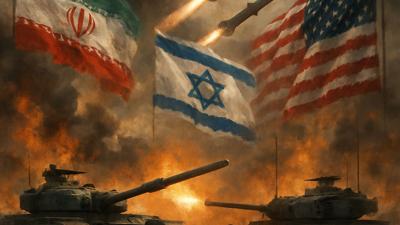


(Shutterstock photo, #2648652819 )
It was still dark across the Middle East when the first flashes lit up the skyline of Tehran. Early Saturday morning, Israel launched a large-scale military strike against Iran, signaling a dramatic escalation after months of mounting tension over Tehran’s nuclear and missile programs.
But this was no ordinary strike — it was a coordinated assault with U.S. military involvement, and American leaders made no effort to downplay that fact.
What Happened
- Israel announced it had launched “preemptive” strikes on multiple targets in Iran — including military facilities and sites in and around Tehran — calling the action necessary to eliminate what it described as existential threats from Iran’s regime and its missile capabilities.
- The United States joined the operation, with President Donald Trump declaring what he called “major combat operations” against Iran.
- Trump went further: in a rare plea directed at the Iranian people, he urged Iranian security forces to lay down their arms and encouraged civilians to “take over your government,” framing the attacks as an opportunity for internal change.
This dual mission has been described by Israeli officials as Operation “Lion’s Roar”, while U.S. sources refer to it as a broader campaign against Iranian military and nuclear infrastructure.
Read more on Chicago Star
Red roses, big names and bigger love: Inside Neal Zucker’s legendary 60th
Uncorked: Chicago, a premier wine celebration returns to Field Museum
Chicago Beer Festival: A night of great brews at the Field Museum
David Schwimmer to host Lookingglass’ most imaginative gala yet
Iran’s Response
Tehran did not wait long. Within hours of the joint strikes:
- Iran launched missiles and drones in retaliation, targeting both Israeli territory and U.S. military bases across the Middle East, including in Bahrain, Kuwait, Qatar, and other Gulf states.
- Gulf states scrambled to intercept incoming projectiles, and cities from Jerusalem to Abu Dhabi sounded air-raid sirens amid the escalation.
- Iran’s leadership publicly vowed “no leniency,” calling the attacks violations of international law and urging the United Nations to act.
Civilian Impact and Emergency Responses
As explosions echoed across Iran’s cities:
- Smoke was seen rising over Tehran, and long lines formed at gas stations as civilians sought safety or tried to flee urban centers.
- Reports — still incomplete and hard to verify — suggested dozens of civilians were killed, including dozens of school children in strikes on urban areas.
- In Israel, authorities declared a state of emergency, closed airspace, and urged citizens to follow shelter protocols.
The Geopolitical Fallout
This conflict has already rattled the international system:
- Russia condemned the U.S.–Israel operation, calling it an “unprovoked act of armed aggression” and urging a halt to hostilities.
- The European Union and other actors called for calm and a return to diplomacy even as missiles continue to fly.
- Markets and energy prices are expected to feel immediate effects, given Iran’s strategic position near the Strait of Hormuz — a critical artery for global oil.
Why This Matters
This is not a localized regional skirmish. Analysts warn:
- The strikes could trigger a wider Middle Eastern war, drawing in allied groups, proxy forces, and global powers.
- Diplomatic efforts to curtail nuclear proliferation — once fragile but ongoing — are now overshadowed by military confrontation.
- Civilian safety, energy markets, and international law are all being upended in real time.
What You Need to Know Now
1. California-style escalation: This is a major coordinated military attack, not a limited skirmish.
2. Regional response is fierce: Iran has retaliated, and missiles/drones have hit Israeli territory and U.S. bases.
3. Civilians are in danger: Smoke, explosions, and casualties have been reported in Tehran and beyond.
4. Global impacts: Energy markets and geopolitics are reacting to an open conflict involving major powers.
5. Peace prospects dim: Diplomatic efforts to rein in nuclear and missile programs have given way to battlefield decisions.
Sources:
https://www.nytimes.com/live/2026/02/28/world/iran-strikes-trump
https://apnews.com/live/live-updates-israel-iran-february-28-2026
https://www.nbcnews.com/world/iran/live-blog/israel-iran-live-updates-rcna261099




(0) comments
Welcome to the discussion.
Log In
Keep it Clean. Please avoid obscene, vulgar, lewd, racist or sexually-oriented language.
PLEASE TURN OFF YOUR CAPS LOCK.
Don't Threaten. Threats of harming another person will not be tolerated.
Be Truthful. Don't knowingly lie about anyone or anything.
Be Nice. No racism, sexism or any sort of -ism that is degrading to another person.
Be Proactive. Use the 'Report' link on each comment to let us know of abusive posts.
Share with Us. We'd love to hear eyewitness accounts, the history behind an article.