

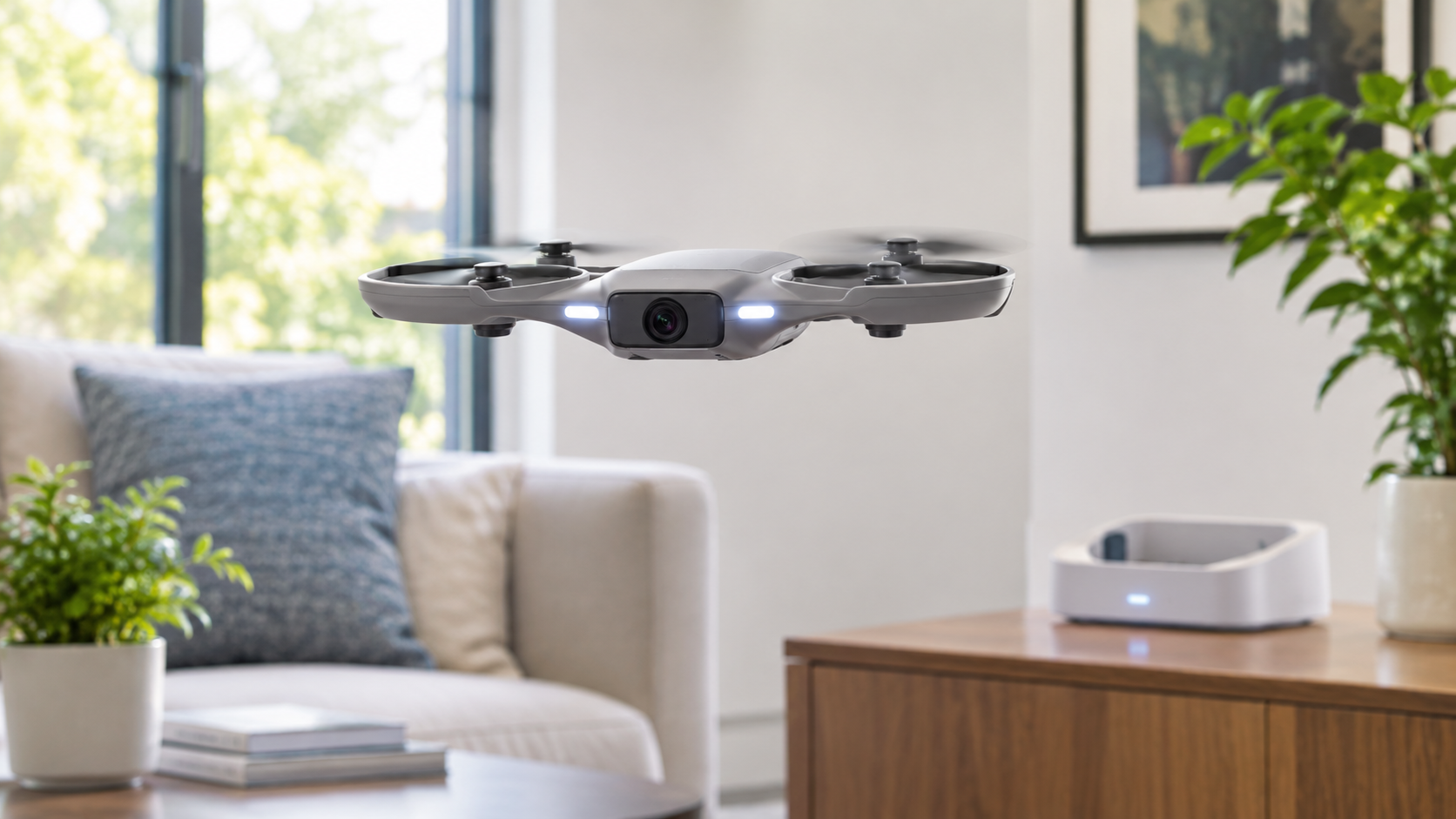
A new generation of home security cameras can fly from room to room, giving homeowners a moving view of their interiors. (AI generated)
Home security is taking flight, literally. Amazon-owned Ring is preparing to introduce a flying indoor security camera that promises to give homeowners a bird’s-eye view of what’s happening inside their homes, without installing cameras in every room. But the high-tech gadget is already generating some unexpected attention, and not all of it is for the reasons Ring might have hoped.
The new Ring Drone Cam, priced at $249.99, is expected to begin shipping Jan. 27, 2027, pending required Federal Communications Commission authorization. First announced more than six years ago, the long-delayed product represents Ring’s latest attempt to expand beyond traditional doorbell and stationary security cameras and into autonomous home robotics.
You may like these Chicago Star articles:
• Cheers to 30 years! Christkindlmarket debuts 2026 collectible collection
• Donnie Wahlberg and Jenny McCarthy’s St. Charles estate hits market for $2.8 million
Unlike a conventional security camera, the compact drone lifts off from its charging dock and travels from room to room, following predetermined patrol routes. Using a system called AI Pilot, it maps a home's interior, identifies potential patrol points and navigates around furniture and other obstacles. Homeowners can use the Ring app to send it to specific rooms, check on areas of interest or schedule patrols while they're away.
The camera captures video in 2K resolution, has a 148-degree field of view and features LED spotlights to illuminate dark spaces. It can fly for up to eight minutes before returning to its docking station to recharge. Ring also emphasizes privacy: The camera stops recording when the drone is docked.
The idea is to provide an additional layer of security without requiring homeowners to outfit every room with a separate camera. If a connected Ring device detects activity or an alarm is triggered, the Drone Cam can take off and investigate, potentially giving homeowners a closer look at what's happening.
But there's a catch. Despite being controlled through the Ring app, the Drone Cam will not offer manual flight controls when it launches. Instead, users will direct it to preset destinations and viewpoints, with its AI system handling the actual flying.
That decision became a bigger talking point after a demonstration for CBS News went spectacularly off course. During a segment with technology correspondent Jo Ling Kent, Ring founder Jamie Siminoff initially offered her the opportunity to pilot an early version using a smartphone. The drone crashed twice during the demonstration. Ring attributed the first incident to a malfunction in its collision-avoidance technology and said the second occurred after the device lost internet connectivity.
Subscribe to Chicago Star’s Weekly City Buzz Newsletter
The second mishap was particularly concerning because the drone is designed to stop and land safely if it loses its connection. That didn't happen during the demonstration. Siminoff acknowledged the failure, saying the device was supposed to stop and land but did not.
Following the demonstration, Ring confirmed to The Verge that manual flight controls would not be available to consumers at launch. The company said autonomous flight to designated patrol points offers the best customer experience.
The question now is whether homeowners are ready to welcome a flying security device into their living rooms. While the concept could appeal to people who want to monitor a larger home, check on pets or investigate suspicious activity without installing multiple cameras, its usefulness for the average household is less obvious.
There are practical considerations, too. Eight minutes of flight time means this isn't a device designed for continuous monitoring. And while the compact drone may be able to navigate around furniture, its presence could be less welcome among pets, young children or anyone who isn't particularly fond of buzzing flying objects indoors.
Still, Ring is betting that consumers will see value in having security that moves rather than simply watches from a fixed position. Whether the $250 gadget becomes a must-have home security tool or an expensive novelty remains to be seen. For now, Ring has certainly given homeowners something new to keep an eye on, even if that eye happens to be flying overhead.
Sources:




(0) comments
Welcome to the discussion.
Log In
Keep it Clean. Please avoid obscene, vulgar, lewd, racist or sexually-oriented language.
PLEASE TURN OFF YOUR CAPS LOCK.
Don't Threaten. Threats of harming another person will not be tolerated.
Be Truthful. Don't knowingly lie about anyone or anything.
Be Nice. No racism, sexism or any sort of -ism that is degrading to another person.
Be Proactive. Use the 'Report' link on each comment to let us know of abusive posts.
Share with Us. We'd love to hear eyewitness accounts, the history behind an article.