

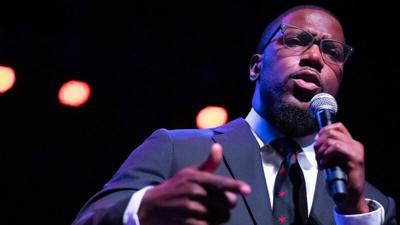
In 2013, community activist Jahmal Cole launched My Block, My Hood, My City, a Chicago-based nonprofit organization that connects teens from disadvantaged neighborhoods with the places, people and possibilities the city has to offer.
Born in Libertyville, Cole attended Reuther Central High School in Kenosha, Wisc., and went on to graduate from Wayne State College in 2005 with a degree in communications. In 2011, he earned a master’s degree in internet marketing from Full Sail University Online.
Cole’s recognitions include the 2020 American Red Cross Community Impact Hero Award, the 2019 Champion of Freedom Award and a spot on Crain’s “40 Under 40” list. He regularly participates in speaking engagements around the city and has authored several books, including “Exposure Is Key: Solving Violence by Exposing Teens to Opportunities” and “50 Excuses to not Follow Your Dreams.”
Cole, a resident of Chatham, has a daughter, Khammur Monet.
How did you develop the concept for My Block, My Hood, My City?
The only concept is to help people. So, I've had this since I was 4 years old. The earliest memories that I have are giving speeches about helping people and listening to Dr. King and Malcolm X. So, I don't know anything different. I don't even know what else I'm good at. I've always known I was going to do it. I didn't know I was calling it My Block, My Hood, My City until I started helping people at the Cook County Jail.
What are some ways the organization has given back to the community throughout the pandemic?
Everything we do is giving back, even if it's effort. We don't have programs, per se, we create programs based upon whatever happens in Chicago. If there's a snowstorm, you'll see us shoveling snow. If there's a heat wave, we deliver water and we deliver fans for seniors. Throughout the pandemic, over 8,000 seniors reached out to us from 12 different states, and we had seniors and we had youth that were unemployed and out of school ...we hired 85 teenagers to contact over 8,000 seniors. They had contact tracing, they connected the seniors with primary healthcare physicians, they shipped out PPE, food, every week for eight weeks. We paid them for eight weeks. That was a way to respond. And then also, my community, Chatham, was turned into almost a food desert because of the looting. We started a small business relief fund and raised $1 million to deliver to businesses that needed help with glass repair, graffiti removal, construction and stuff like that. We helped out over 300 businesses with $7,500 grants.
What do you find most meaningful about your role with the organization?
What I love about my life is that it allows me to help people, and they use me to help people. I enjoy living in Chicago. I love Chicago. I like having a movement that allows everybody to get involved. We don't have to have a master's to make a difference, or a law degree. We can do several things. At My Block, My Hood, My City we offer an on-ramp to community engagement for folks who want to get involved. I really love that.
What does being a leader mean to you?
Asking a lot of questions. Trying your best to understand. Moving forward even when you're uncertain.
What are some of the challenges you faced growing up, and how have they shaped the person you are today?
I didn't know a food stamp wasn't real money until I tried to put one in the washing machine and it broke. I grew up living in a motel and living in the back of a U-Haul truck, and seeing my parents split up left and right. It was tough on a kid. A lot of my role models went to jail for drugs, a lot of my cousins. Everyone went to jail, my whole life. Everybody. Just being able to dream bigger than my surroundings was a challenge. Ultimately, it played a part in why I do what I do today.
Who has been the biggest role model in your life?
Definitely my father. He never had no money growing up, and we grew up living in the back of a U-Haul truck. We ate at homeless shelters growing up—Thanksgiving dinner, I ate at homeless shelters. But he never let me hold my head down and be embarrassed that I was wearing thrift store clothes and living at the shelter. He'd always make me hold my head up high, and even if my friends were volunteering at the shelter, he would still make me go get my food. He always instilled in me that I was going to be a senator, I was going to be a leader in the world, and he just never wavered. He always believed in me. So, he was my best role model.
How have your experiences with homelessness influenced the work that you do?
Once you're homeless and you've got to live in the streets, you don't ever judge people. You always have a lot of empathy for people, because you know what it be like. And that empathy can move to compassion when you start doing something about it. But you always have empathy. You never look down on people. You can talk to a wide spectrum of people, because you've been there. It keeps you humble. And that ability has never left me.
This year in particular has highlighted many divides that exist in our country and our city, especially in terms of race and politics. How can we best bridge those divides as a community?
By doing things together. Volunteering together. We just put holiday lights on King Drive, and the significance is people of all different colors and genders and religions and opinions and ethnicities and occupations, everybody came together to do something positive on King Drive. Chicago is a very segregated city, and I could talk about why that's important for days. But at the end of the day, people connect based upon their energies and their vibes and their values. In this country, we separate people by the color of the skin. In other countries, they do it by all types of things ... We need to start asking ourselves, who's profiting by creating these divides amongst people? Is it the Republican Party? Is it Yahoo and their search engines? Is it rich people who don't want poor people to unite, to face our judicial system that puts poor people in jail for stealing crumbs, while corporate CEOs are making billions of dollars off people's jail time? So, we've got to ask ourselves, who's profiting by keeping us apart?
What makes mentorship opportunities so crucial for teens from underserved areas of the city?
If you show people better, they can do better. But if they don't know any better, they can't do better. I never saw a college graduate until I was 18. When I saw a black college graduate, I knew I could do it. If people never see it, how could you be it? If all you've ever seen is a rapper or a basketball player on TV, you don't know you can be a doctor, or anything. You don't know you can be a consumer engagement specialist. How would you know if you never saw it? You have to be able to see it. So, that's why being a mentor—you can call it a mentor if you want, but that's a made-up term—is, will you answer the phone when someone text messages you at 2 in the morning? Will you pay that light bill for that family? Will you be in that kid's life? That's really what it is.
What do you hope teens take away from participating in My Block My Hood My City?
That it's their responsibility to go back when they graduate and pull somebody off the block. And then they can really just show them that they want them to see success in different forms, beyond rap and basketball. There are so many options for things you can do. You have access to so many opportunities. Just step outside your comfort zone, and you'll get it.
What steps can the city take to help support at-risk youth?
I would start with simple things. There shouldn't be 15 currency exchanges in a neighborhood—no thanks. That's crazy. The billboards shouldn't be cheap divorces and $6,000 cash advances. There shouldn't be more technology in the lightbulbs than in the classrooms. You shouldn't have to order your food through bulletproof glass windows. It is simple stuff. You've got to design a city that's inspirational.
What do you most value about Chicago?
That there's always something to do. You feel, this is a stage, the ground one. As an activist, I can't have a better life. There's always something to do, people to help, some things that need changing. And I love helping. So, there is always some help to do in the city.



(0) comments
Welcome to the discussion.
Log In
Keep it Clean. Please avoid obscene, vulgar, lewd, racist or sexually-oriented language.
PLEASE TURN OFF YOUR CAPS LOCK.
Don't Threaten. Threats of harming another person will not be tolerated.
Be Truthful. Don't knowingly lie about anyone or anything.
Be Nice. No racism, sexism or any sort of -ism that is degrading to another person.
Be Proactive. Use the 'Report' link on each comment to let us know of abusive posts.
Share with Us. We'd love to hear eyewitness accounts, the history behind an article.