

By Elizabeth Czapski, Staff Writer
(Published March 18, 2019)
Behind every street name in Chicago, there’s a story to tell, and the West Loop’s streets are no exception. Streetwise Chicago by Don Hayner and Tom McNamee gives the history of every street in Chicago. Here are four of the West Loop’s most interesting street names.
W. Randolph St.
Randolph Street is one of the West Loop’s most prominent streets and largely considered Chicago’s “Restaurant Row.” Before Girl & The Goat, before Au Cheval, there was a man named James Thompson, who created Chicago’s first street plan in 1830 for the Illinois and Michigan Canal Commission. According to a WTTW story on street names, Thompson “created streets and lots from Kinzie to Washington and Jefferson to Dearborn;” at this time, the population of Chicago was below 300. Thompson refused the offer of Chicago real estate as payment and took a horse instead.
Thompson was from Randolph County in southern Illinois, and he “probably named [the street] for that reason,” write Hayner and McNamee. The authors of Streetwise go on to talk about John Randolph, a U.S. Senator from Virginia, but according to an 1859 history of Randolph County, the name came from Edmund Randolph (1753-1813). Born in Williamsburg, Virginia, Randolph was the U.S.’s first Attorney General and second Secretary of State, after Thomas Jefferson.
W. Randolph St. runs from N. State St. to the east to N. Ogden Ave. on the border of Union Park.
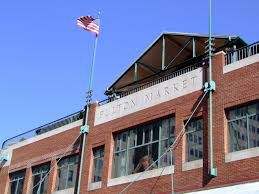
W. Fulton Market
Fulton Market (and Street, and Drive, and Boulevard) was named after Robert Fulton (1765-1815), a painter and inventor. According to PBS.org, he was born in Pennsylvania and moved to Europe to become a portrait painter—he even painted Benjamin Franklin. While abroad, Fulton became interested in ships and steam engines. Although he didn’t invent the steamboat, he debuted the first commercially successful steamboat, the Clermont, on the Hudson River in 1807, and within five years had steamboats running on six major rivers.
Not limiting himself to steamboats, Fulton also tested the first successful submarine in 1804.
Fulton Market runs from east to west, from N. Desplaines St to N. Oakley Blvd. East of Desplaines and west of Oakley, Fulton Market becomes Fulton Street.
W. Kinzie St.
Kinzie St. was named for John Kinzie (1763-1828). Hayner and McNamee describe Kinzie as “one of Chicago’s earliest settlers and probably the first Chicagoan to be pursued by the law.”
Originally from Quebec, Kinzie was a fur trader and a silversmith. In 1804 he moved into the former house of John Baptiste Du Sable, Chicago’s first permanent non-indigenous resident. Kinzie’s run-in with the law occurred in 1812, when he killed Jean Lalime, Fort Dearborn’s Native American interpreter, with whom Kinzie had a long-standing feud. Lalime allegedly followed Kinzie home from the fort and attacked him. Police later determined the killing to be a “justifiable homicide.”
However, a Chicago Reader story from 2018 proposes that this version of events might not be the whole truth. Going through records and letters from the time, the story suggests Kinzie, who sold goods to soldiers at Fort Dearborn, was swindling the soldiers through his high prices, may have been blackmailing the fort’s officers, and may have tried to incite a war between Chicago’s settlers and Native Americans. Lalime was suspicious of Kinzie’s motives and got into an argument with him, when Kinzie stabbed him.
No matter what actually happened, Kinzie was not prosecuted and died in Chicago in 1828.
W. Kinzie St. runs east to west, from N. Wabash Ave. to N. Western Ave.
W. Couch Pl.
Couch Place gets its name from Ira Couch (1806-1857), proprietor of the Tremont House Hotel. Couch came to Chicago from New York State in 1836 and rented the Tremont, which stood at Lake and Dearborn, Streetwise reports. The Tremont proceeded to burn down twice, but Couch and his brother James didn’t give up—they built a third Tremont out of brick this time. It became known as “Couch’s Folly,” and was so popular that people often had to sleep in the hallways. Couch became a wealthy man, rented out his hotel, and retired.
You can visit Ira Couch today in his large stone mausoleum in Lincoln Park. According to the Chicago Park District, Lincoln Park used to be a public cemetery, and the Couch family decided the mausoleum would be too expensive to move once the land was converted. Couch is interred there along with several of his family members.
W. Couch Pl. runs east to west, from N. LaSalle St. to the river, then picks up again west of the river from N. Desplaines St. to N. Halsted St.




(0) comments
Welcome to the discussion.
Log In
Keep it Clean. Please avoid obscene, vulgar, lewd, racist or sexually-oriented language.
PLEASE TURN OFF YOUR CAPS LOCK.
Don't Threaten. Threats of harming another person will not be tolerated.
Be Truthful. Don't knowingly lie about anyone or anything.
Be Nice. No racism, sexism or any sort of -ism that is degrading to another person.
Be Proactive. Use the 'Report' link on each comment to let us know of abusive posts.
Share with Us. We'd love to hear eyewitness accounts, the history behind an article.