

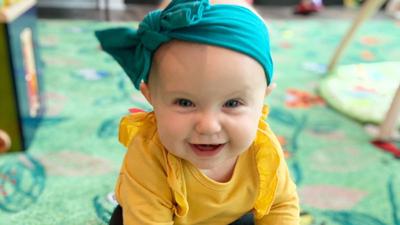
As Illinois heads into the fourth phase of its multi-stage reopening plan, Chicago daycares, preschools and other childcare providers are beginning to welcome back children and families while navigating new state requirements designed to curb the potential spread of COVID-19 through increased sanitation and social distancing measures.
While many daycares were forced to temporarily shut down amid the wave of business closures, others were able to operate on a limited basis by obtaining emergency licenses. One of the first daycares to receive the license was Caterpillar Care, which has locations in East Village, Noble Square and Streeterville.
"We were very proud of that, and we were very happy, because it allows us to keep our doors open to serve essential workers," Caterpillar Care founder and CEO Sharif Nassr said, adding the daycare's partnership with Whole Foods has allowed children to continue receiving healthy breakfasts, lunches and snacks in spite of the shutdown.
Under phase 3 and 4 rules released by the Illinois Department of Children and Family Services, daycares must submit an action plan that addresses procedures such as daily health checks for children and staff members, limits on non-essential visitors and the use of personal protective equipment.
Caterpillar Care has enacted measures such as posting additional signs stating "No mask, no entry," Nassr said.
"If you're symptomatic, we're going to have to turn you away," he said. "At check-in now, rather than having parents sign in and sign out themselves, we have our directors sign in and sign out for the children. And we also do temperature checks."
Nassr and his wife, Diana Lazu — Caterpillar Care's co-founder and vice president — grew the daycare out of a small word-of-mouth operation based out of East Village. Today, Caterpillar Care provides services to 78 families across its three locations, Nassr said.
The events of the past few months have given the daycare new opportunities to educate and connect with the children it serves, he said.
"We have about 25 to 30 books that we've purchased specifically celebrating the diversity in our society, the cultural differences, the religious differences that we have among one another," he said. "We also have some virtual learning, although it's not as heavily focused as some of the other preschools and programs where they go up to maybe 6 or 7 years old. We send a weekly curriculum, and in that curriculum, we're focusing more on some of the challenges that we've had with COVID, like hand-washing techniques, ways you can keep you and your family safe."
Guidepost Montessori at West Loop also obtained an emergency license in the early days of the shutdown and began operating at a limited capacity on March 26. Nearly 20 children of essential workers used the school's services at that time, said Taylor Fleurissaint, assistant head of school.
The school underwent a soft re-opening on June 1, with about six families returning in the first week, she said.
"I think a lot of families are still cautiously optimistic about returning to school," Fleurissaint said. "I think once we get to phase 4, we'll see a lot more families interested in returning to school."
In accordance with the state's new guidelines, the classroom capacity at Guidepost Montessori at West Loop has been reduced. A classroom designated for children aged 3-6 can now accommodate a maximum of 15 children, which has resulted in changes to staffing, Fleurissaint said.
"The new requirements require that there are two staff members in a room at all time, regardless of how many children are there," Fleurissaint explained. "If there's one child, there's still going to be two staff members to keep up with the sanitation requirements. That's definitely affected our staffing, and that's been challenging, because we did have staff on furlough, so we're not able to offer everybody full-time work as they come back."
The school implemented temperature checks for children and staff members, required children to be dropped off and picked up at the door and asked parents to wear masks upon arrival and departure and encourage their children to do the same.
"We're doing our best with sanitizing," Fleurissaint added. "We're encouraging children to social distance as much as we can through the structure of our classrooms, how we're arranging people and chairs and workspaces, and we've found that to be effective."
Because of these changes, no children at the school have gotten sick with COVID-19 since the shutdown began — a feat Fleurissaint described as "pretty remarkable."
"We've had a whole crew of children here for two months, and nobody has been diagnosed with COVID or had any issues like that," she said. "I think not being afraid to send children back is probably the best way to help childcare providers at this time."
Staff members have maintained relationships with families throughout the shutdown by offering virtual learning for children 2 and up, Fleurissaint said.
"Our administration has done a good job of being available to those families, if they have questions about the opening or about being able to send their children back or if they qualify as essential," she said. "We've definitely had a lot of conversations with our families along those lines."
The Gardner School, which operates 20 schools in six states, closed all of its schools in mid-March out of concern for the safety of students and teachers, said Joy Haynes, the organization's marketing manager. Schools are now reopening in phases, with five of the eight Chicago-area facilities reopening June 1 and the remaining three, including the West Loop location, reopened on June 8.
"We opened up our Tennessee and Minnesota schools in May, so we've been running through those procedures with them, and it seems to be going really well or really smoothly," Haynes said.
Students are now required to clean their hands and have their temperature checked prior to entering the building, and parents must pick up and drop off their children just outside the school. Another significant change involves having the students eat in the classroom, rather than in a shared area of the school called the "Kids Cafe."
Many of the measures taken by the schools are designed to keep children in small groups as much as possible, rather than having them move around the building, in order to minimize the risk of an outbreak, Haynes said.
"We do a lot of cleaning anyway, whether it's flu season or not flu season, because we don't want to spread germs, but we obviously are enhancing that cleaning," she said. "So, we're going to do some limited hours, opening just a little bit later and closing just a little bit sooner, so that our staff has time to make sure everything's clean before the children arrive, and then they can also sanitize at the end of the day."
For The Gardner School, maintaining students' safety is a top priority.
"We want them to learn, but we want them to learn in a safe and healthy environment, especially given that the virus is still out there," Haynes said. "We want to make sure that not only can they learn, but we can continue to keep our schools open and our classrooms open and keep everybody healthy."
Alicia Hein, a West Loop resident whose 2-and-a-half-year-old son Thomas attends The Gardner School’s West Loop location, said taking her son to school in the morning has been “super fast and efficient yet thorough” with the new procedures. Parents stand outside in line on marked spots for social distancing when picking up and dropping off their children, and a mobile app helps facilitate the check-in and check-out process, she said.
“The mobile app they use is really great,” Hein said. “Both parents get notifications when their child is checked in or checked out of school and by whom, which makes us feel really secure. And of course we get the usual pictures and meal updates in there as well.”
Hein said the school has helped the children maintain social distancing during meals and nap times, and the children still have opportunities for fun and exercise, such as taking daily walks outside with masks on and using the indoor play gym, which is disinfected between use and limited to one class at a time.
“I would say overall the school and their staff have been extremely diligent and are taking every precaution with the kids,” Hein said. “Our son is loving being back at school and after a week acclimated to the new procedures without issues.”
West Loop resident Barbara Yeung Lu, who has a 5-year-old and a 3-year-old also attending The Gardner School’s West Loop location, said her children’s transition back to school has gone very smoothly.
“At the beginning of the shelter-in-place in March, we explained to them, in a way that they could understand, why places were closed and why everyone had to wear masks,” she said. “They were very accepting of the changes and have been really good with keeping their masks on for a good portion of the day.”




(0) comments
Welcome to the discussion.
Log In
Keep it Clean. Please avoid obscene, vulgar, lewd, racist or sexually-oriented language.
PLEASE TURN OFF YOUR CAPS LOCK.
Don't Threaten. Threats of harming another person will not be tolerated.
Be Truthful. Don't knowingly lie about anyone or anything.
Be Nice. No racism, sexism or any sort of -ism that is degrading to another person.
Be Proactive. Use the 'Report' link on each comment to let us know of abusive posts.
Share with Us. We'd love to hear eyewitness accounts, the history behind an article.