

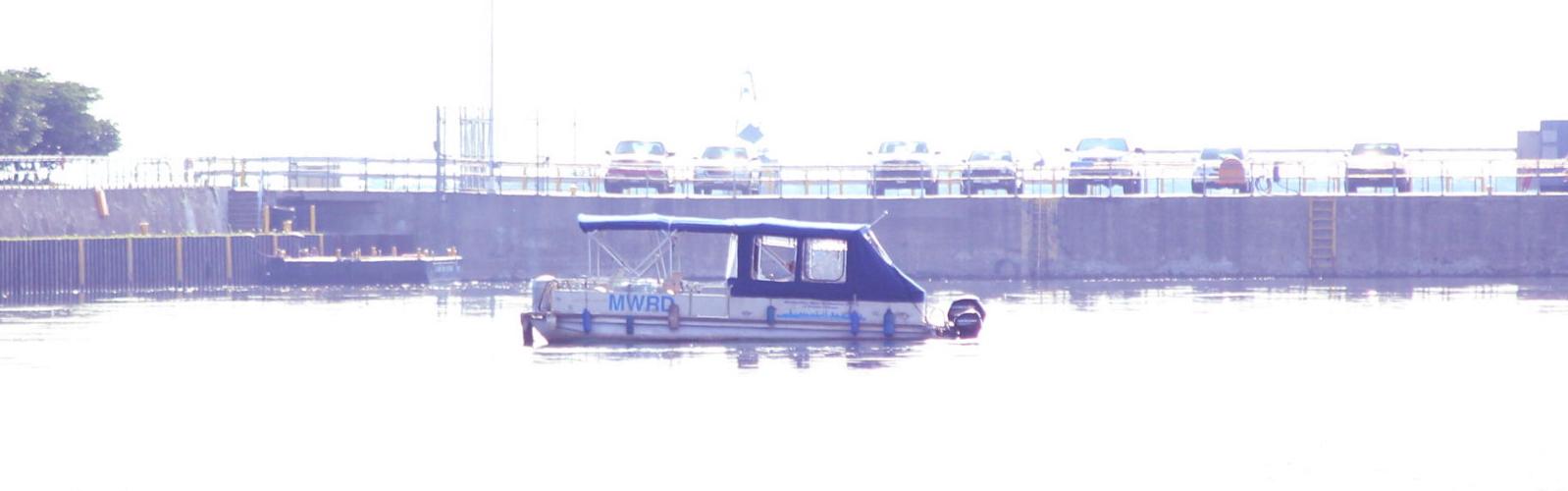
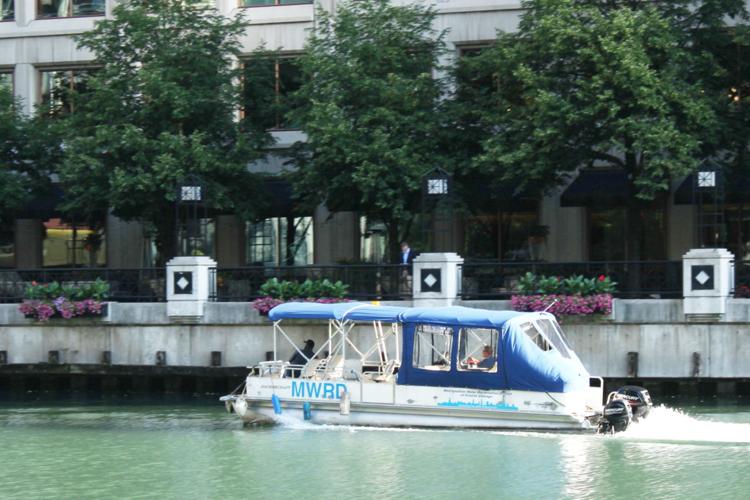
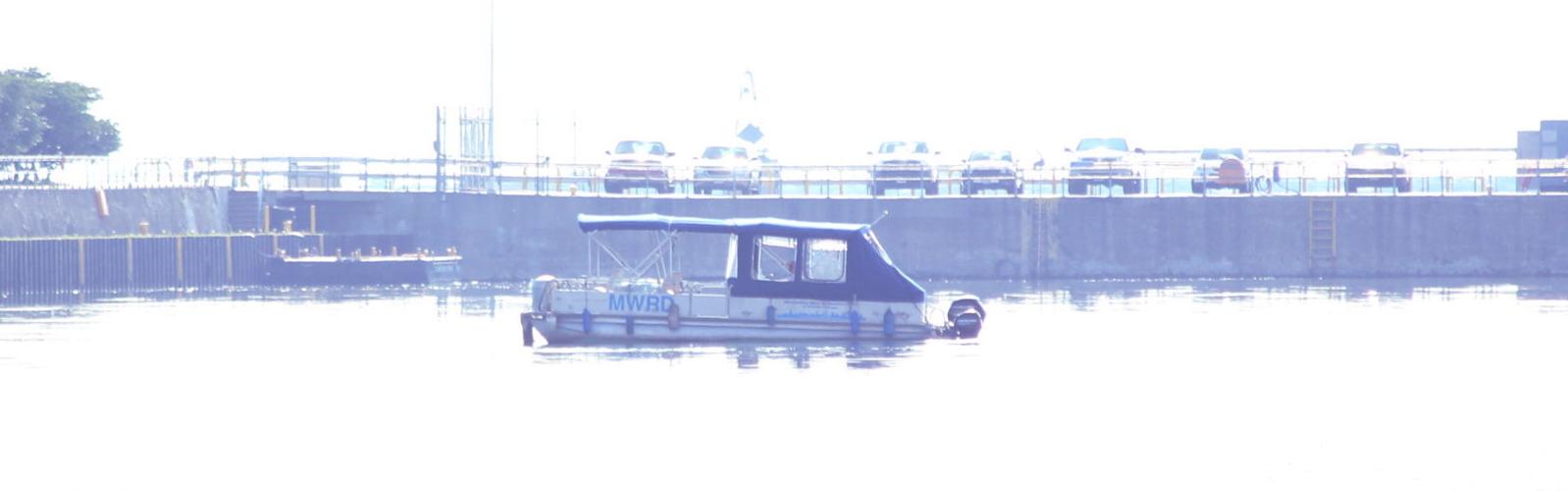
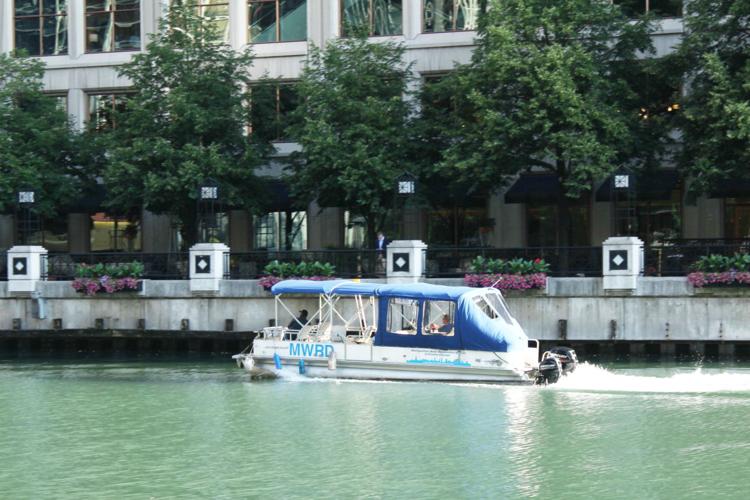
Floating on the surface of the Chicago River, Skim Pickens and Skimmy Dipper look like a couple of slow pontoon boats gathering debris into baskets between their hulls. But underneath the pair of vessels is a century of history that extends 300 feet below the water.
“On a typical run, they pick up aluminum cans, glass bottles, Styrofoam cups, plastic bags and sometimes sporting goods like tennis balls and basketballs,” says Brian Levy, a civil engineer with the Sanitary District of Chicago and Metropolitan Water Reclamation District of Greater Chicago (MWRD), the governmental agency that owns and operates the boats. “There’s an urban legend that they once found some money, but it turned out to be counterfeit.”
Every weekday from April to October, the 23 foot-long catamarans leave their dock at the Chicago River Controlling Works in DuSable Harbor around 7:30 a.m. They cruise westward at roughly 5 mph through the River Walk until reaching the fork behind the Merchandise Mart. There, they separate and proceed north to Goose Island and south to Ping Tom Memorial Park. Along the way, they remove any visible waste that fits into the four- by eight-foot receptacles.
The boats reinforce a commitment to clean drinking water that began when city and state officials decided to reverse the flow of the Chicago River in 1887 and, two years later, created the Chicago Sanitary District, which is now the Metropolitan Water Reclamation District.
The river that they navigate is artificially elevated to 577.48 feet above sea level by a series of dams, tunnels, and drains that keep it moving southward to the Chicago Sanitary and Ship Canal, where it joins the DesPlaines and then the Illinois Rivers before reaching the Mississippi. The process of reversing its flow was completed in 1900 and named a “Civil Engineering Monument of the Millennium” in 1999.“We established an elevation level about a hundred years ago and we kept it,”
Mr. Levy explains. “It’s about 50% of my responsibilities.”
The area’s infrastructure is designed to prevent anything that drains into the sewers from reaching the river. On normal days, the city’s sewers accept household waste and the MWRD’s sewers collect and send this waste, along with street runoff, to one of seven water treatment plants. But heavy rains occasionally back them up. When this occurs, the District’s “Deep Tunnel” becomes a last ditch effort to prevent trash from floating to the top.
Located 300 feet below the ground, measuring thirty feet in diameter, and connected to the sewer system by a series of drop shafts, the deep tunnel is the star attraction of 1972’s Tunnel and Reservoir Plan (TARP), another grand engineering feat by the Metropolitan Water Reclamation District.
“It’s a 109 miles of tunnels that start in Wilmette at the Bahai Temple and pretty much follow the course of the Chicago River,” says Mr. Levy.
Tunnel construction began in 1975 and the tunnel was operational by 2006. The MWRD has now moved on to the next portion of the project, which includes the Majewski, the Thornton Composite, and the McCook Reservoirs.
The Thornton Reservoir was completed in 2015. It is located near South Holland, IL, and holds a capacity of 7.9 billion gallons of water, making it the largest combined sewer reservoir in the world. The McCook Reservoir west of Midway Airport will be constructed over two phases beginning next year. When completed in 2029, it will be even larger, holding ten billion gallons. Along with the Majewski Reservoir, they should be able to handle whatever the connecting Deep Tunnel sends their way.
But if a storm drops more than TARP can take, the excess flows up into the river, where the skimmer boats will do extra weekend duty if needed.
Although Mr. Levy jokes that, “It’s not like I woke up one day and thought ‘hey I’m gonna clean garbage’” the Marquette civil engineering grad is proud to list the benefits of MWRD’s cleanup efforts.
“We are constantly measuring the amount of dissolved oxygen in the water,” he says. “We make sure that the fish have sufficient oxygen to breathe.”
Since the early 70s, the number of species identified in the Chicago River has increased from roughly ten to sixty.




(0) comments
Welcome to the discussion.
Log In
Keep it Clean. Please avoid obscene, vulgar, lewd, racist or sexually-oriented language.
PLEASE TURN OFF YOUR CAPS LOCK.
Don't Threaten. Threats of harming another person will not be tolerated.
Be Truthful. Don't knowingly lie about anyone or anything.
Be Nice. No racism, sexism or any sort of -ism that is degrading to another person.
Be Proactive. Use the 'Report' link on each comment to let us know of abusive posts.
Share with Us. We'd love to hear eyewitness accounts, the history behind an article.