
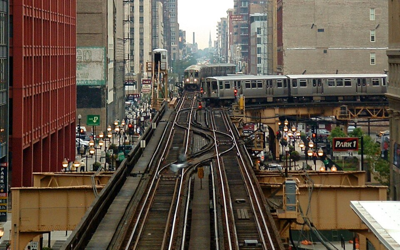

In a significant announcement for “L” line riders across the city, Chicago’s State and Lake station will be shutting down for reconstruction beginning Monday, Jan. 5. The project, which is expected to last roughly three years, was announced by the Chicago Transit Authority (CTA) last week as part of their ongoing efforts to modernize the city's public transit and upgrade long-standing stations across the city in need of repair.
At 130 years old, the State and Lake station is one of the oldest in the city, dating back to 1895 when it was erected as part of the original downtown “Loop” system. The stop's history and location have made it one of the iconic symbols of Chicago’s famed and unique elevated train system.
Along with its historical relevance, the State and Lake station also sits at a critical junction for both commuters and those looking to transfer trains, with five separate lines, the Brown, Green, Pink, Purple, and Orange running through the stop, making it the 5th busiest station in the city, according to the CTA.
The project, which began preliminary work over the summer, will completely close the State and Lake station and is also expected to affect some street-level traffic, with road closures anticipated periodically throughout the construction process.
- Why the Joffrey Ballet's “tweaked” “Nutcracker” is a must-see
- Art Institute Unveils $50M Granger Conservation Center
- Wrapped in kindness: gifts that give back this holiday season
The rebuild will be a complete overhaul of the station, featuring new improvements such as a state-of-the-art glass canopy cover to protect riders from the elements, wider platforms for safety and space, energy-efficient LED lighting, and new elevators that will make the stop fully ADA compliant. The project will also aim to improve safety and traffic flow at street level by removing unneeded support columns and optimizing obstructed sidewalks.
For many living downtown, the “L” can be a double-edged sword, offering cheap, efficient (sometimes!) public transportation, but also adding to the noise of an already bustling city, and for some, it can be an eyesore against the backdrop of Chicago’s stunning architecture.
However, whether a gift or a curse, as the CTA continues its modernization efforts and more and more historical stations are converted to modern transport hubs, Chicagoans can reflect on the unique nature of the city’s elevated train lines and the iconic role it has played in the infrastructure and cultural history.




(0) comments
Welcome to the discussion.
Log In
Keep it Clean. Please avoid obscene, vulgar, lewd, racist or sexually-oriented language.
PLEASE TURN OFF YOUR CAPS LOCK.
Don't Threaten. Threats of harming another person will not be tolerated.
Be Truthful. Don't knowingly lie about anyone or anything.
Be Nice. No racism, sexism or any sort of -ism that is degrading to another person.
Be Proactive. Use the 'Report' link on each comment to let us know of abusive posts.
Share with Us. We'd love to hear eyewitness accounts, the history behind an article.