
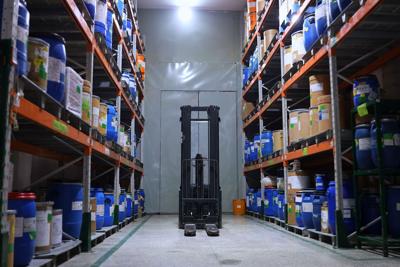
The supply chain for the pharmaceutical industry typically involves a number of different important stakeholder groups, such as wholesalers, pharmacies, manufacturers, distributors and healthcare providers, all of whom often extend over several countries. Being able to accurately track medicine as it moves across these different stakeholders is a difficult logistical challenge, one that can become complex when products are recalled or the authenticity of a batch is questioned.
It might seem like the blockchain is predominantly only used for trading digital assets, but that is not exactly the case. Popular exchanges like Binance don't just allow users to track the Ethereum to USD exchange rate; they also provide research and discussion into how blockchain technology can be used for applications that have very little, or even nothing at all, to do with the speculative trading of digital assets. Pharmaceutical supply chains are just one area where blockchain technology could provide a digital record solution that would make it easier to track and verify products.
Subscribe to Chicago Star's Weekly City Buzz Newsletter
The use case for blockchain technology here is not overly complicated: rather than relying on individual records that are held by each separate stakeholder, participants in the supply chain could use infrastructure built on the blockchain to record events, such as medicine passing through, as the distribution process unfolds. While this, naturally, doesn't hold any guarantee that a product is genuine or a batch will remain untainted, it does make it much easier to track how a batch of medicine has moved and makes it easier to find discrepancies in the supply chain process.
Why is pharmaceutical supply-chain traceability important?
The traceability of pharmaceutical medicines can be important because there are so many different places that medicine can pass through before it reaches its intended destination and the patient. Systems that would be able to accurately and easily track and map where medicine started and how it got to its eventual destination, including exactly who handled it and where it was stored, could help regulators, distributors and manufacturers to act quickly when something goes wrong.
Data from the World Health Organization (WHO) estimates that 1 in 10 medicines in low- to middle-income countries are falsified or of substandard quality. The WHO also estimates that around $30.5 billion USD every year is spent on those poor-quality products. It goes on to say that the increasing complexity of the pharmaceutical supply chain has made increasing the rate of medicine quality hard to achieve.
All of which is to say that there is a very real application for improving how the pharmaceutical supply chain is handled. Blockchain-based systems could be used as a shared record-keeping system that would allow all transactions to be verified quickly and easily.
How exactly could blockchain improve medicine tracking?
Because blockchain ledgers are immutable, they are highly resistant to being tampered with, which means that they could provide a very trustworthy source of information storage for events that occur along a supply chain.
As an example of how this could look for the pharmaceutical supply chain, the manufacturer would register that a batch of medicine has left the production location; the distributor would record that they received it; then the transfers to the wholesaler and pharmacy would be recorded. Throughout the process, the products would have a unique identifier, and all records would be associated directly with that identifier, right up until the product is sold. This would provide a very clear digital history for any pharmaceutical products as they move towards sale.
This would make it a simple thing to investigate any products that are deemed to be suspicious. There would be no need to compare different databases and pieces of information about a product's journey along the supply chain; the shared record could be directly accessed instead.
There are already certain drugs that are mandated by the US Food and Drug Administration's Drug Supply Chain Security Act (DSCSA), so there is precedent for such a system existing in the pharmaceutical supply chain.
Could blockchain help with counterfeit medicines?
Indirectly, yes. Blockchain systems would make it much harder to manipulate supply-chain history that has already been recorded, but they would be unable to stop fraudulent information being entered in the first place.
This is an important difference. When products are initially placed on the supply chain, if they are marked incorrectly or fraudulently from the beginning, there is nothing inherently existing within the blockchain that would detect this. This is why physical verification of goods, appropriate identification technologies and using trusted organizations throughout a supply chain is still important.
It seems likely that the future of pharmaceutical supply chain management will involve the integration of blockchain systems into existing supply chain infrastructure.
Read more on Chicago Star
- Morningstar to join Google, moves global headquarters to Chicago’s Thompson Center
- Hall of Famer Jim Thome adds $1M downtown condo as White Sox make playoff run
- Booker Prize winner “Orbital” takes center stage as the 2026 “One Book, One Chicago” pick
- Former Illinois Sen. Kirk Dillard downsizes after 26 years, sells $1.2M Hinsdale property
Could blockchain make pharmaceutical recalls faster?
Yes, definitely. The better the digital tracking system underlying the supply chain, the easier and simpler it will be to identify exactly which products need to be recalled and where they have been sent.
The framework of the FDA's DSCSA is designed to explicitly improve this. The FDA claims that more powerful electronic tracing of the supply chain will help participants identify and trace products.
It isn't hard to imagine the use case. If a manufacturer discovers that one specific batch of a product has been tainted in some way, and every event regarding that batch has been accurately entered into a shared record, it would be much simpler to contact any pharmacies, healthcare providers or wholesalers that have received products from that batch.
In essence, blockchain would be able to make pharmaceutical recalls much more surgical in which batches of a product are recalled, which would make recalls occur faster.
Author: Liam Clarke
Liam is a content writer from Australia. He has been writing content for years and has a flexible style that allows him to write content to suit many topics. When he isn't writing content, he's watching classic films and providing enrichment for his cat.




(0) comments
Welcome to the discussion.
Log In
Keep it Clean. Please avoid obscene, vulgar, lewd, racist or sexually-oriented language.
PLEASE TURN OFF YOUR CAPS LOCK.
Don't Threaten. Threats of harming another person will not be tolerated.
Be Truthful. Don't knowingly lie about anyone or anything.
Be Nice. No racism, sexism or any sort of -ism that is degrading to another person.
Be Proactive. Use the 'Report' link on each comment to let us know of abusive posts.
Share with Us. We'd love to hear eyewitness accounts, the history behind an article.