

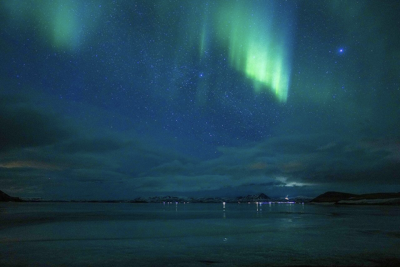

NOAA has upgraded its forecast for the northern lights, placing a G3 strong geomagnetic storm watch in effect for Thursday, June 4, through Friday, June 5 UTC, as three coronal mass ejections (CMEs) move toward Earth, according to the NOAA Space Weather Prediction Center.
The agency said geomagnetic field conditions are expected to rise quickly from quiet to active, reaching strong storm levels mid- to late on Thursday, June 4, and continuing into the following day. NOAA also said there is a chance of isolated G4 severe storms at the peak of the event, per Forbes.
The forecast update follows multiple Earth-directed CMEs launched after solar activity increased on Wednesday, June 3, and Thursday, June 4, according to EarthSky. CMEs are clouds of charged gas and magnetic fields thrown into space by solar flares.
Subscribe to Chicago Star’s Weekly City Buzz Newsletter
Where auroras may be seen
The best viewing chances remain in Washington, Idaho, Montana, Wyoming, the Dakotas, Minnesota, Wisconsin, Michigan, New York and Maine, according to NOAA’s forecast discussion, Forbes said. Additional chances may extend into Oregon, Nebraska, Iowa, Illinois, Indiana, Ohio, Pennsylvania, Massachusetts, Connecticut, Rhode Island, Vermont and New Hampshire.
If storm strength briefly reaches severe levels, the aurora could push farther south than usual. NOAA and SpaceWeather.com said visibility will also depend on clear skies, light pollution and the direction of the solar wind magnetic field when the CMEs arrive.
NOAA said exact timing is difficult to pin down and that the most reliable forecasts often come only about 30 minutes before peak activity. An 82%-lit waning gibbous moon could also make faint auroras harder to see.
Read more on Chicago Star
Knicks steal game 1 from Spurs, 105-95—Jalen Brunson on fire after halftime sneaker change
Aryna Sabalenka loses bid for French Open title to Diana Shnaider
Jamie Lee Curtis mourns sister Kelly Curtis, who passed at age 69
Bret Michaels, others drop out of Great American State Fair, a celebration of America’s 250th
What to watch tonight
The agency said the display could begin around Thursday afternoon and evening in North America, with impacts possibly lasting into Friday night. Space weather observers often watch the Kp index, but NOAA said the key factor is whether the magnetic field turns southward, which can strengthen aurora activity.
For the latest updates, NOAA urged skywatchers to check real-time space weather reports through its forecast pages and aurora-monitoring tools, as conditions can change quickly.




(0) comments
Welcome to the discussion.
Log In
Keep it Clean. Please avoid obscene, vulgar, lewd, racist or sexually-oriented language.
PLEASE TURN OFF YOUR CAPS LOCK.
Don't Threaten. Threats of harming another person will not be tolerated.
Be Truthful. Don't knowingly lie about anyone or anything.
Be Nice. No racism, sexism or any sort of -ism that is degrading to another person.
Be Proactive. Use the 'Report' link on each comment to let us know of abusive posts.
Share with Us. We'd love to hear eyewitness accounts, the history behind an article.