

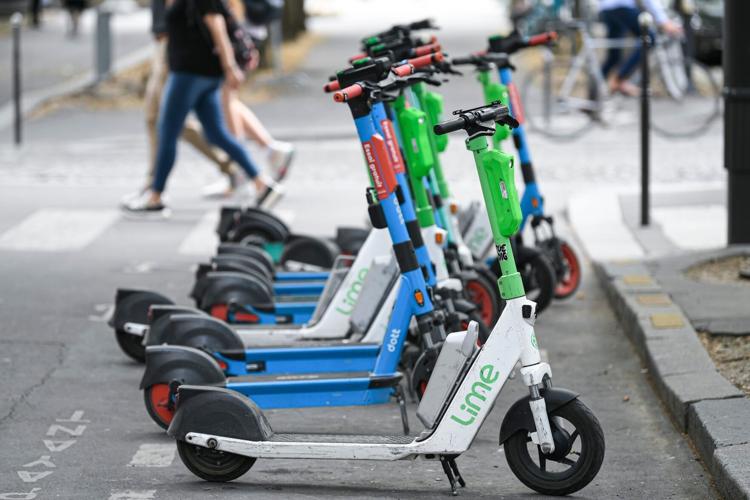

Lime, a San Francisco-based electric scooter company, is considering expanding its operations to the Lakefront Trail in Chicago. According to Crain’s, the company is still in the early stages of this effort, which began after Lime riders showed interest in accessing the trail.
Lime scooters came to Chicago in 2019 through a pilot program partnership with the city. The company is currently collecting data to support a case for allowing e-scooters on the Lakefront Trail, and a survey was sent out last month to gather users’ opinions on the matter. Lime plans to collaborate with stakeholders such as the Chicago Department of Transportation, the Chicago Park District, the Office of the Mayor and various community partners before making significant decisions.
The Lakefront Trail currently restricts e-scooter access, contrary to e-bikes, which are allowed. E-bikes are allowed on most city streets or bike paths in Chicago for riders over the age of 16. Electric bikes share many rules with regular bikes, but are restricted on sidewalks, and their speed is limited to 20 mph.

The Lakefront Trail currently allows pedestrians, bikes, and electric bikes. | Photo courtesy of Shutterstock
As of last year, Lime scooters and e-scooters from Lyft, Spin, and Superpedestrian are approved on most streets and paths in the city through a two-year license. Their potential expansion to the Lakefront Trail has the support of transportation safety advocates who believe the scooters contribute to car-free infrastructure. However, opposition is anticipated from several bicycle advocacy groups prioritizing pedestrian and cyclist usage of the trail and Chicago Park District officials are not currently discussing any expansion.
Active Trans, a biking and walking advocacy group, believes that adding Lime scooters to the Lakefront Trail would deter walkers and further diminish the city’s public transportation system. Nonetheless, Lime plans to move forward with its efforts after the survey data is processed.
The author generated this text in part with GPT-3, OpenAI’s large-scale language-generation model. Upon generating draft language, the author reviewed, edited, and revised the language to their own liking and takes ultimate responsibility for the content of this publication.




(0) comments
Welcome to the discussion.
Log In
Keep it Clean. Please avoid obscene, vulgar, lewd, racist or sexually-oriented language.
PLEASE TURN OFF YOUR CAPS LOCK.
Don't Threaten. Threats of harming another person will not be tolerated.
Be Truthful. Don't knowingly lie about anyone or anything.
Be Nice. No racism, sexism or any sort of -ism that is degrading to another person.
Be Proactive. Use the 'Report' link on each comment to let us know of abusive posts.
Share with Us. We'd love to hear eyewitness accounts, the history behind an article.