


If the Chicago Bears thought a successful season, an emerging franchise quarterback, and a beloved new head coach would quiet the discourse around the team heading into the offseason, boy, would they be wrong.
Chicagoans have watched from a distance as first Arlington Heights, and now Hammond, Indiana, battle over the rights to develop the new Chicago Bears stadium—a chronicle that has ebbed and flowed relentlessly over the past two years and still doesn't seem to have a clear vision for where the tale might end.
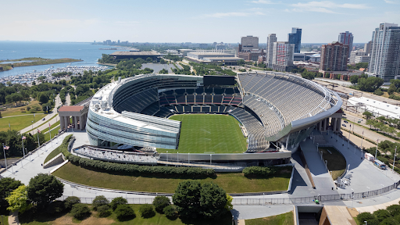
But regardless of what happens in the ongoing saga, it remains that Soldier Field will face uncertainty in the wake of its most significant tenant's departure.
Read more on Chicago Star:
Last week, the Park District of Chicago, the entity that has owned the lakefront stadium since its construction in 1924, put forth its plans for what a Bears-less Soldier Field future might look like.
Per a report from WGN Chicago, at its core, the proposal is a holistic $630M investment that aims to turn the 101-year-old stadium into an elite, year-round concert venue. The plans lay out a blueprint that allocates $130M to direct stadium renovations, such as upgrades to backstage areas, locker rooms, seating layouts and a new sound system; the remaining $500M would go toward surrounding infrastructure projects, including improved parking, public transit, and pedestrian walkways.
While the Bears' lease with Soldier Field continues until 2033, they would have the ability to break the contract for designated penalty fees. The stadium also currently plays host to the Chicago Fire, but the MLS team has its own plans for expansion with the upcoming development of its standalone stadium along the Chicago River’s south branch, expected to be completed by 2028.
According to a report from Fox News Chicago, Soldier Field remains the park district's largest revenue driver outside of taxes, further solidifying the need for the stadium to remain a valuable city asset.
The proposal will be reviewed internally by city officials, with formal next steps not likely to occur in the near future, given the continued uncertainty surrounding the Bears' new home. Regardless of what happens next, one thing is for sure: the future of one of Chicago’s most recognizable landmarks will look a lot different from the way it has for the last century.




(0) comments
Welcome to the discussion.
Log In
Keep it Clean. Please avoid obscene, vulgar, lewd, racist or sexually-oriented language.
PLEASE TURN OFF YOUR CAPS LOCK.
Don't Threaten. Threats of harming another person will not be tolerated.
Be Truthful. Don't knowingly lie about anyone or anything.
Be Nice. No racism, sexism or any sort of -ism that is degrading to another person.
Be Proactive. Use the 'Report' link on each comment to let us know of abusive posts.
Share with Us. We'd love to hear eyewitness accounts, the history behind an article.