

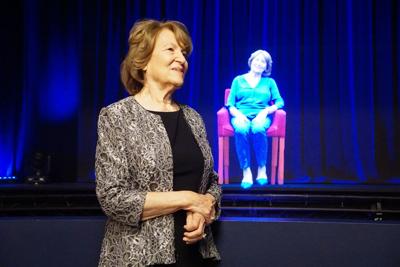

As a Survivor of the Holocaust and the President of Illinois Holocaust Museum & Education Center, Fritzie Fritzshall devoted her life to combating hatred and prejudice, inspiring people to become Upstanders instead of bystanders, and speaking out to make our world a better place. Everywhere she spoke, she changed people's lives and the way they see the world. I know because I am a witness. She passed away recently at age 91, and during her lifetime, she influenced all who met her or heard her words.
“Fritzie was the heart and soul of our Museum,” said Susan Abrams, CEO of Illinois Holocaust Museum & Education Center. “She played an important role in the Museum transforming from regional player to global leader, sharing her story of survival and its lessons through cutting edge technology including interactive holograms and virtual reality film. I regularly watched in awe as Fritzie mesmerized audiences with her story and its lessons. All who were touched by her will never forget. She was an inspiration to me and to so many others.”
During the Holocaust, Nazis occupied Fritzie's hometown of Klucharky, Czechoslovakia, and deported her, her mother and two brothers to Auschwitz-Birkenau concentration camp when Fritzie was just a young teenager. Her mother, two younger brothers and other family members were murdered.
“There is no way to describe what it was like to be in the rail car hungry, cold, without food, without water, watching pregnant women begging for water, watching different people dying in front of you from lack of food, air, and water,” Fritzie said. “My own grandfather died in this car going to Auschwitz.”
To survive, she pretended to be older than she was. Fritzie endured a torturous year in Auschwitz and a related Nazi labor camp, where she worked doing slave labor in a factory. In 1945, she was finally liberated by the Soviet Army after escaping into a nearby forest during a death march.
After the war, in 1946, Fritzie came to Skokie, Illinois, and reunited with her father, who worked for Vienna Beef and had come to America before the Holocaust to provide his family with money from abroad. Fritzie married a U.S. veteran of World War II who had been a prisoner of war in the Pacific, and she made a life for herself in Chicagoland as a hairdresser, becoming an avid Cubs fan in the process.
Fritzie's call to activism began in the late 1970s when neo-Nazis threatened to march through the streets of Skokie. The terror and outrage of seeing swastikas in their community galvanized a group of Survivors to establish the Holocaust Memorial Foundation of Illinois in 1981 to fight bigotry with education. The Foundation was a small but passionate operation housed in a modest storefront on Skokie's Main Street.
“We said we came to a free country, and we don't need to be afraid to say we are Jews,” she recalled. “We don't need to be afraid to walk out on the street and be identified. We are not wearing the yellow armbands any longer.”
Fritzie, along with 20 Chicagoland Holocaust Survivors who were meeting in one Survivor's basement, had the dream of one day opening an educational institution that would preserve Survivor stories and teach the lessons of the Holocaust to current and future generations.
In 1990, Fritzie, with other Survivors, convinced Governor James Thompson to sign the first Holocaust Education Mandate into law, making Illinois the first state in the country to require the teaching of the Holocaust in all public elementary and high schools. “I want to encourage teacher training and student learning about man's continued inhumanity to man,” Fritzie said.
In 2009, Chicagoland Survivors' long-held vision of opening a world-class educational institution became a reality with the opening of Illinois Holocaust Museum & Education Center on Woods Drive in Skokie. It is the third-largest Holocaust museum in the world, and, since 2010, Fritzie served as its President.
Fritzie, in a 2019 interview, said, “I want the world to remember and to know to never, ever, ever, ever forget about the Holocaust. We say ‘never again,’ but we don't often mean ‘never again.’ ‘Never again’ must be ‘never again.’ It must stop.”
Governor J.B. Pritzker, the first Chairman of the Museum’s Board of Trustees, comments, “Fritzie wanted us to know that there are good people everywhere. Even in the most difficult, threatening, and horrific circumstances, goodness might be present. She spent much of her life teaching children and adults that we all need to be like the stranger who saved her life on the train that day at Auschwitz. ‘One person can make a difference’ she always said....Fritzie was that person who made a difference for many. She embodied the decency and kindness she implored from others. She was strong and faithful and caring. A fundamentally good person is gone today. I miss her already, and I will never forget her.” (www.ilholocaustmuseum.org)




(0) comments
Welcome to the discussion.
Log In
Keep it Clean. Please avoid obscene, vulgar, lewd, racist or sexually-oriented language.
PLEASE TURN OFF YOUR CAPS LOCK.
Don't Threaten. Threats of harming another person will not be tolerated.
Be Truthful. Don't knowingly lie about anyone or anything.
Be Nice. No racism, sexism or any sort of -ism that is degrading to another person.
Be Proactive. Use the 'Report' link on each comment to let us know of abusive posts.
Share with Us. We'd love to hear eyewitness accounts, the history behind an article.