
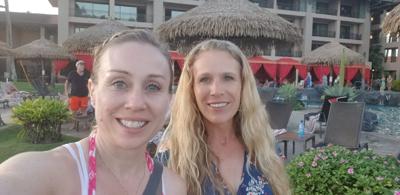
LEWISTOWN — Rebekah Rhoades and Shaundra Schaff have been friends a long time — almost all their lives. But recently they shared an experience most friends never will: that of being a kidney donor and a kidney recipient.
“We both grew up in Absarokee. We’ve known each other since elementary school, but when we became really close is when we roomed together in college,” Rebekah said. “I knew for a long time that Shaundra had kidney disease, but she didn’t talk about it much. She’s pretty tough.”
For years Shaundra dealt with the issue mostly by herself. That changed two years ago, when she was put on the list of those needing a kidney transplant.
“I was diagnosed with an autoimmune kidney disease as a child,” Shaundra said. “Immune thrombocytopenia, ITP, is a rare disease. They don’t know the cause, but basically my immune system attacked my kidneys and caused nephropathy. That’s damage that ultimately leads to kidney failure, usually within a 20-30 year time frame.”
“We were really close and we sometimes talked about how she was doing, but things got more serious about five years ago when her lab work started showing her kidneys were starting to fail. We talked about her needing a transplant and then, about two years ago, she was put on the transplant list and I realized things had gotten serious,” Rebekah said.
It was at that point Rebekah began wondering whether she would be a match as a donor.
“They were checking her family members and I thought, ‘I should get tested,’” she said.
First, though, came some heart-to-heart discussions with her own family.
“They had questions, but they know how close Shaundra and I are, and in the end they supported my decision,” Rebekah said.
So she took that next step, undergoing an initial screening and lab work in Billings.
“It was looking good. They said there was no reason I couldn’t be a donor,” Rebekah said. “That’s when I called Shaundra and said ‘I’m doing this.’ She was really emotional, which is a switch because usually I’m the emotional one.”
“We talked about it a lot,” Shaundra said. “It’s a big sacrifice. There were a lot of conversations about what it meant for both our families.”
For the next step Rebekah had to travel to AdventHealth Porter Hospital in Denver, Colorado, for additional testing. Taking that additional step meant deepening her friendship with Shaundra.
“On the donor side, the medical testing doesn’t cost anything,” Rebekah said. “But there are layers you need to think about. What if something goes wrong with the surgery, or what if another person is a better match? I didn’t want Shaundra to feel she owed me for life if anything happened.”
“And I didn’t want Rebekah to feel like she was obligated to do this,” Shaundra said. “It’s hard to be on the receiving end, knowing the impact it could have.”
However Rebekah said the more she learned about the process and the need for live donors, the more she felt it was something she needed to do.
“I really wasn’t scared of the medical procedures; that stuff doesn’t really bother me,” she said. “I just felt I wanted to go through with this.”
In the end, Rebekah was not as close a match as Shaundra needed.
“Both Rebekah and my brother were tested. One of the tests is for eplets (clusters of amino acids on human antigen molecules) and both were a moderate match. The best match would be low or zero, not moderate, because the kidney will last longer and you can take less anti-rejection drugs,” Shaundra said.
The testing happened during the summer of 2022, but at that time Shaundra wasn’t quite ready to get a transplant just yet.
“Once you get a transplant, it’s not all roses and butterflies,” Rebekah said. “She wasn’t ready so I stepped back and waited.”
That wait ended this fall with a paired transplant process. Rebekah, the donor, gave a kidney that went to someone else, allowing Shaundra, the recipient, to get a kidney that more closely matched her genetics.
Rebekah said she was “in and out” of surgery that started at 4:30 a.m. and lasted about three hours.
“They had me up and walking that afternoon. I was sore, and I reacted to something and had a rash, but overall, it wasn’t anything major.”
However when her husband told her the kidney she donated had taken and that Shaundra’s surgery went well, that was a different story.
“Then I was very emotional,” she said. “I have no regrets about having done this. It’s not for everybody, but for me it was the right thing.”
“It was life-saving,” Shaundra said. “The only way to live without kidneys is to be on dialysis for life. It’s a big deal, the gift of her friendship and love.”
“I’ve had some people tell me, ‘I might do this for a family member, but not for a friend,’” Rebekah said. “There are different levels of friends, and this was something I needed to do for Shaundra.”
For Rebekah, the surgery and recovery meant taking two weeks off from her job as clerk of the Lewistown School District, while Shaundra was able to return to her home in Bozeman last weekend.
“There is such a need for donors,” Shaundra said. “It’s challenging but it’s life. It’s a big deal.”
For more information about kidney transplants, visit the American Kidney Fund website at kidneyfund.org.




(0) comments
Welcome to the discussion.
Log In
Keep it Clean. Please avoid obscene, vulgar, lewd, racist or sexually-oriented language.
PLEASE TURN OFF YOUR CAPS LOCK.
Don't Threaten. Threats of harming another person will not be tolerated.
Be Truthful. Don't knowingly lie about anyone or anything.
Be Nice. No racism, sexism or any sort of -ism that is degrading to another person.
Be Proactive. Use the 'Report' link on each comment to let us know of abusive posts.
Share with Us. We'd love to hear eyewitness accounts, the history behind an article.