
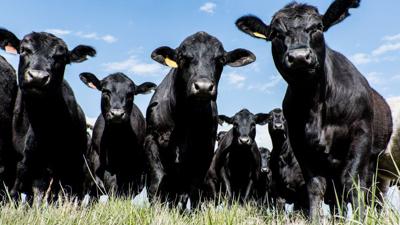
Science has brought the livestock industry a long way over the year when it comes to breeding specifically for certain traits in animals.
Depending on a breeder’s location and market they are in, they can emphasize or de-emphasize traits to benefit their business.
Patrick Wall, a beef field specialist for Iowa State University Extension, said when it comes to the commercial industry, they look at breeding cattle for growth and maximum dollars per head.
Wall said breeders use a bioeconomic index to keep from overemphasizing one trait in an animal. Maternal traits can determine whether someone keeps or sells a female sow while terminal traits focus on the production of bulls and calves in the feed yard.
“Based on the role of a breed and what they are known for we try to maximize those traits,” he said.
When it comes to predicting what traits may be desirable in cattle in the future, some that Wall noted include fertility, longevity and feed efficiency. Wall thinks that breeding for animal health will be part of that – breeding cattle that don’t get sick and that can survive in tough environments.
“Feed yards won’t have to treat animals for diseases or give vaccinations to the animals to prevent them from getting certain diseases,” Wall said.
In different regions of the United States, cattle breeders may want their cattle to be able to survive with a lack of resources. Wall said these traits are more desirable for those keeping cattle in the desert Southwest or arid areas.
“Most of the upper Midwest have abundant feed and breeders are not worried about limited resources,” he said.
When it comes to selecting traits for pigs, what is desired by breeders has changed over the years.
Timothy Safranski, professor at the College of Agriculture, Food and Natural Resources at the University of Missouri and Extension swine breeding specialist, said in the early ‘90s packers paid for lean swine. They would select pigs that would grow faster and have more muscling.
He said 10-15 years ago there were bigger litters and lighter-weight piglets.
Selection of swine has changed since then and now suppliers select for the number alive on day 5, which has helped a lot.
“We have suppliers that should not have more pigs,” Safranski said. “They have mother pigs that have more piglets than nipples to feed them.”
The new genetic focus has allowed them to take pressure off the litter size. Instead of focusing on litter size they are now looking at sow lifetime production and longevity with more emphasis on physical structure, mainly the feet and legs of the sows.
“One of the reasons that a sow leaves the farm is the inability to reproduce or lack of soundness in the physical structure of their feet and legs,” Safranski said.
One of the things he believes will be desirable in the future is breeding for growth rate.
“As long as production is the same this is fine,” Safranski said. “If you are selecting for faster growth, it can affect muscle fiber, taste and texture of the product.”
He said the industry will never have animals that are too efficient.
Another desirable future trait he sees is for disease resistance, but that could be unique to each population, he said.




(0) comments
Welcome to the discussion.
Log In
Keep it Clean. Please avoid obscene, vulgar, lewd, racist or sexually-oriented language.
PLEASE TURN OFF YOUR CAPS LOCK.
Don't Threaten. Threats of harming another person will not be tolerated.
Be Truthful. Don't knowingly lie about anyone or anything.
Be Nice. No racism, sexism or any sort of -ism that is degrading to another person.
Be Proactive. Use the 'Report' link on each comment to let us know of abusive posts.
Share with Us. We'd love to hear eyewitness accounts, the history behind an article.