

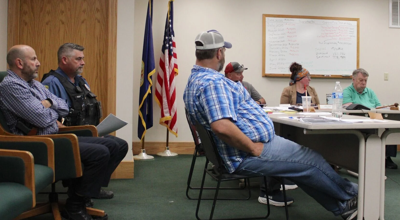
A proposal originally intended to replace aging police vehicles may soon expand into a broader effort to address officer retention, recruitment and long-term public safety funding in Miles City. During the City Council work session on Tuesday, June 16, council members delayed action on a proposed public safety mill levy after discussions expanded beyond equipment needs.
The levy was originally proposed as a one-year measure that would generate approximately $260,000 to replace aging police vehicles and related equipment. However, discussion during the work session shifted toward whether the levy should instead be expanded into a multi-year funding source that would also support wage increases for police officers.
The conversation emerged following labor negotiations and ongoing discussions about staffing levels within the Miles City Police Department.
Police Chief Doug Colombik told council members the department is facing increasing challenges in recruiting and retaining officers as wages in neighboring communities remain above that of Miles City.
“We are averaging five to 10 dollars an hour less than similar-sized Class 2 cities across the state,” Colombik said.
The department currently employs 14 officers despite being budgeted for 16 positions, with Colombik noting there are at least six officers “actively looking” for positions elsewhere.
Colombik described a law enforcement hiring environment that has become increasingly competitive throughout Montana and across the country. While agencies once attracted applicants through benefits packages, work environments or community amenities, he said today’s applicants are placing far greater emphasis on salary.
“They’re not looking at the benefits or how good the working environment is or how good the fishing or hunting is,” Colombik said. “They’re looking for a big black number, and that’s salary.”
The department currently starts first-year officers at approximately $24.76 per hour.
He said retention has become just as important as recruitment. While some turnover is expected in any department, Colombik again told the council that the city is spending significant resources training officers only to see them leave for higher-paying agencies after gaining experience.
Colombik described the situation as urgent, warning that continued staffing losses could eventually affect the department’s ability to provide services at current levels.
“I’m hesitant to say certain things in public meetings,” Colombik said. “But … I can say that this police department won’t be able to function unless there’s an immediate impact to fix this issue right now.”
The chief said he has tracked officer departures throughout his career and believes the current situation represents one of the most serious retention challenges he has seen.
Council members spent considerable time discussing how much funding would be needed to make a meaningful impact.
While no formal proposal was presented, discussion suggested bringing wages closer to regional averages could require an additional $150,000 to $175,000 annually. Combined with vehicle and equipment needs, the department’s total funding requests would exceed the amount contemplated in the original levy proposal and would likely require a levy lasting longer than the proposed one-year sunset.
Councilwoman Jeni Losey said the idea emerged during ongoing union negotiations.
“In the union negotiations, it is very clear that there needs to be something done with wages, and a lot of that has to do with retention,” Losey said. “We’re just bleeding fire and police officers, and replacing them is very expensive.”
Council President Brooke Bartholomew noted that concerns about wages emerged during labor negotiations earlier in the day and prompted questions about whether a public safety levy could help address the issue.
The possibility of expanding the levy raised questions about what voters might be willing to support.
Some members of the council questioned whether equipment and wages should be combined in a single levy proposal or be separated into different questions.
“I think people would be more likely to say, ‘yeah, we need to give them a raise and keep them around’ versus ‘we need to get a bunch of stuff,’” said Councilman Eddie Pulecio. “I realize you need the equipment too, but then it would be a little bit less because it wouldn’t keep putting that $260,000 out every year for the next however many years.”
It was also noted that personnel costs are ongoing and unlikely to disappear after a set period, circling back around to the broader financial questions facing the city.
Colombik acknowledged that the department’s needs must be balanced against overall city finances but argued that public safety remains a foundational service.
“For everything to exist in this community, it starts with public safety,” he said. “The safety of your homes, your children, the schools, the businesses.”
No action was taken during the work session.
Instead, council members voted to postpone consideration of the levy while additional information is gathered regarding potential funding levels, levy structures and budget impacts and draft an updated version that may include a larger amount for a longer period of time.
The council must finalize any ballot language by early August if it intends to place a public safety levy before voters in the upcoming November election.




(0) comments
Welcome to the discussion.
Log In
Keep it Clean. Please avoid obscene, vulgar, lewd, racist or sexually-oriented language.
PLEASE TURN OFF YOUR CAPS LOCK.
Don't Threaten. Threats of harming another person will not be tolerated.
Be Truthful. Don't knowingly lie about anyone or anything.
Be Nice. No racism, sexism or any sort of -ism that is degrading to another person.
Be Proactive. Use the 'Report' link on each comment to let us know of abusive posts.
Share with Us. We'd love to hear eyewitness accounts, the history behind an article.