

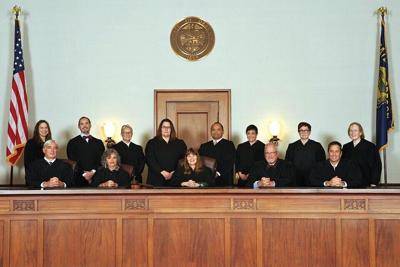
SALEM — On Dec. 26, the Oregon Appeals Court affirmed a lower court decision in Francisco Almanza-Garcia v. Jamie Miller, Superintendent, Snake River Correctional Institution (Appeals case number A182843; Circuit Court case number 20CV36944).
The Appeals Court issued a nonprecedential memorandum opinion, meaning the case does not set a new precedent. In law, a precedent is a court decision that serves as an authority for future cases with similar facts or legal issues.
Jason Weber and Equal Justice Law filed the brief for appellant petitioner - Almanza-Garcia.
Ryan Kahn, an Assistant Attorney General for the Oregon Department of Justice, waived appearance.
The decision was made by a two-judge panel consisting of Chief Judge Erin Lagesen and James (Jim) Egan, as authorized by ORS 2.570(2)(b). Egan authored the memorandum opinion.
Background
The U.S. Supreme Court made a decision in Ramos v. Louisiana (2020) in which it ruled that conviction by a nonunanimous jury constituted an unconstitutional denial of the Sixth amendment right to a jury trial. Before the ruling, a single juror’s vote to acquit was enough to prevent a conviction in 48 states as well as the federal system. But two States, Louisiana and Oregon, did not require unanimous verdicts. In this case, petitioner Evangelisto Ramos was convicted of a serious crime in a Louisiana court by a 10-to-2 jury verdict. Instead of the mistrial he would have received in most jurisdictions, Ramos was sentenced to life without parole. Justice Samuel Alito wrote the lone dissenting opinion in the case.
Decision
Almanza-Garcia appealed a judgment denying him post-conviction relief. His appointed counsel filed a brief pursuant to ORAP 5.90 and State v. Balfour, 311 Or 434, 814 P2d 1069 (1991).
In 2007, a Marion County Grand Jury indicted Almanza-Garcia on two counts of Rape in the First Degree and one count of Sodomy in the First Degree for crimes he committed against a minor female when she was between 7 and 8 years old. Following a bench trial, the Marion County Circuit Court convicted him of all three charges and sentenced him to consecutive sentences totaling 900 months in prison.
Although the petitioner had not preserved his claim of error in the trial court, the Oregon Court of Appeals found the medical opinion testimony constituted plain error and remanded the petitioner's case for a new trial in 2011.
In 2012, after a second trial, the jury unanimously found him guilty of all three charges, and the trial court once again imposed an aggregate 900-month prison term.
In the most recent appeal, the petitioner argued, among other things, that his jury instructions allowed for nonunanimous verdicts. However, the verdicts in petitioner’s case were unanimous. For that reason, the post-conviction court in Malheur County dismissed the petition.
"Having reviewed the record, including the post-conviction court file and the transcript of the hearings, and having reviewed the Balfour brief, we have identified no arguably meritorious issues," concluded the memorandum.
The Oregon Court of Appeals, created in 1969, is the first level of appeal following trial. The court has jurisdiction to hear all civil and criminal appeals from circuit courts, except death penalty cases, and to review most state administrative agency actions. The Chief Justice of the Supreme Court appoints the Chief Judge from among the thirteen judges on the Court of Appeals.
Antonio Sunseri is a reporter for the Argus Observer and Independent-Enterprise. Contact him at (541) 823-4802 or [email protected].




(0) comments
Welcome to the discussion.
Log In
Keep it Clean. Please avoid obscene, vulgar, lewd, racist or sexually-oriented language.
PLEASE TURN OFF YOUR CAPS LOCK.
Don't Threaten. Threats of harming another person will not be tolerated.
Be Truthful. Don't knowingly lie about anyone or anything.
Be Nice. No racism, sexism or any sort of -ism that is degrading to another person.
Be Proactive. Use the 'Report' link on each comment to let us know of abusive posts.
Share with Us. We'd love to hear eyewitness accounts, the history behind an article.