

As we continue in the Advent Season let us focus on the Lord, “who crowneth thee with loving kindness and tender mercies” Psalm 103:4.
A few days ago we celebrated Thanksgiving. Indeed, we have so much to be thankful for, that one day a year is inadequate. Suppose we set aside an entire month? That, too, is inadequate. May we be like David and make our gratitude known to God every day by the way we live and practice love as Jesus taught us when He said, “Love thy neighbor as thyself.”
The wildflower for today is the last of the six asters that I have found in this area. There are probably more but they are difficult to identify except by botanists. Even they have had problems with the process because the aster is one wildflower sub-family that seems to cross-pollinate freely at times creating another variety.
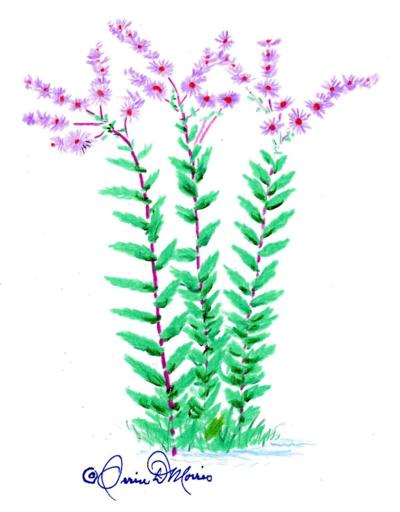
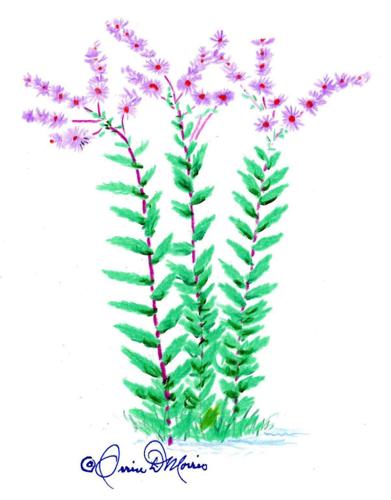
PURPLE-STEMMED ASTER Aster puniceusAsters are in the sunflower family with a central cluster of florets surrounded by rays. The purple-stemmed asters along my driveway have violet-blue rays (“petals”) though sometimes the flowers are white.
The purple-stemmed aster is one of the larger among the many asters, a 1 1/4 inch bloom. The central disk of this aster is reddish, whereas several other white asters are yellow. Other distinguishing differences include the configuration of leaves, habitat, height and, of course, the stem.
The leaves of this aster are serrated. At the base of the stem they may be as long as 6 inches. Toward the top of the stem, the leaves are shorter, clasping the stem alternately, as pictured.
The usual habitat of the purple-stemmed aster stretches from Newfoundland to the piedmont of Georgia. It requires very moist soil, such as along streams and rivers. I am fortunate that there is a spring-fed bog along my driveway that requires a culvert. My neighbor has a small pond that captures the runoff and that is where we enjoy the purple-stemmed asters each fall, usually in September and October.
Most asters range between 1 and 3 feet tall. Not so with this one. As it thrives in its moist habitat, it may grow as tall as 7 feet, according to “A Field Guide to Wildflowers,” by Peterson and McKenny. Those that grow along my driveway rarely get above 3 feet.
The common name gives us the first clue to identifying this aster, however, there are other asters whose stems are dark. This Aster’s stems are purple and hairy.
May the Lord “crown your life with loving kindness and tender mercies” as you make time in your life for the coming of the Christ Child.




(0) comments
Welcome to the discussion.
Log In
Keep it Clean. Please avoid obscene, vulgar, lewd, racist or sexually-oriented language.
PLEASE TURN OFF YOUR CAPS LOCK.
Don't Threaten. Threats of harming another person will not be tolerated.
Be Truthful. Don't knowingly lie about anyone or anything.
Be Nice. No racism, sexism or any sort of -ism that is degrading to another person.
Be Proactive. Use the 'Report' link on each comment to let us know of abusive posts.
Share with Us. We'd love to hear eyewitness accounts, the history behind an article.