
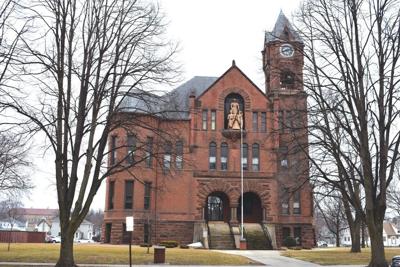

Steele County is establishing its first-ever Restorative Justice Advisory Committee, which will set parameters for referring cases, primarily involving juveniles, for restorative conferencing — a less punitive alternative to the traditional court system. (File photo — Owatonna.com)
From education to criminal justice, there’s a growing conviction in many sectors of society that punitive measures are not the best way to right every wrong.
Exploring alternatives to traditional court procedures, Steele County is in the process of establishing a Restorative Practices Advisory Committee (RPAC), which will primarily be used to address cases involving juveniles. The committee will include representatives from law enforcement, local schools, victim advocacy organizations and other key stakeholders, but the county is also seeking community members to participate.
According to County Attorney Robert Jarrett, one of the primary purposes of the committee will be to set parameters for referring cases to local restorative practice initiatives. While he has ideas of his own, he wants to hear the ideas that come forward from the committee.
He cited truancy and juvenile delinquency, like vandalism, as prime examples of cases that might be best served through restorative practices.
Through the newly formed Office of Restorative Practices, the state is incentivizing counties and jurisdictions to establish RPACs. Per statute, the committee must represent the racial and socioeconomic diversity of the county. Jarrett said he he’s looking for seven or eight individuals to serve on the committee, and he has a handful identified already.
The Minnesota Department of Corrections defines restorative justice, a subset of restorative practices, as a victim-centered approach that seeks to repair harm, while also holding people accountable for their actions. It emphasizes that crime is harmful to victims, offenders and communities as a whole, and seeks dialogue and mutual agreement to the extent possible, as opposed to retribution.
In total, the committee will include around 20 people, and will likely meet quarterly. Its first meeting is scheduled for Jan. 10, taking place remotely. One of Jarrett’s goals for the RPAC is to refer appropriate cases to restorative conferencing.
According to Jarrett, a restorative conference has little in common with a court session.
A conference may take place in a library or school conference room, as opposed to a courtroom. The county is partnering with Rochester-based nonprofit Three Rivers Restorative Justice to provide and train facilitators for the conferences. During a session, one conference leader will work with the offender while the other works separately with the victim, until they’re ready for a face-to-face discussion.
Jarrett said the process is designed to be “less adversarial” for the two parties.
“It’s more mediation than anything else. Eventually we get to a point where we come to the table together and talk together. It takes time to get there, but that’s the goal,” he said.
In addition to committee members, the county is currently looking for community members to volunteer to facilitate conferences. Training will be provided by Three Rivers at no charge.
Victims and offenders cannot be required to participate in a conference, although there may be legal benefits in doing so. Jarrett, who previously worked for the Rochester Police Department, said Rochester has had great success applying restorative practices to school fights.
Establishing an RPAC is a prerequisite for obtaining grant dollars from the state, which Jarrett said would help provide case workers for Truancy Court, which the county is reviving in February after the program fizzled out amidst the challenges of social distancing and remote sessions during the pandemic. United Way of Steele County, which has been collaborating with local authorities on truancy initiatives, has applied for the state grant on the county’s behalf. Jarrett expects to know whether the county will receive the funds in February or March.
Jarrett said UWSC’s truancy efforts in local schools have been “very effective” thus far, offering intervention before a case would require something like Truancy Court.
Truancy Court will operate much like Steele-Waseca Drug Court, holding students accountable for their behavior and helping them to solve their problems. Since the program fell by the wayside, Jarrett said there’s been no real consequence for truancy — and students know it. He sees it as adding another step to local truancy reduction efforts, and backing up the existing system with more “teeth” when necessary.
TO VOLUNTEER
Anyone interested in serving on the Restorative Practices Advisory Committee should contact the county attorney at [email protected]




(0) comments
Welcome to the discussion.
Log In
Keep it Clean. Please avoid obscene, vulgar, lewd, racist or sexually-oriented language.
PLEASE TURN OFF YOUR CAPS LOCK.
Don't Threaten. Threats of harming another person will not be tolerated.
Be Truthful. Don't knowingly lie about anyone or anything.
Be Nice. No racism, sexism or any sort of -ism that is degrading to another person.
Be Proactive. Use the 'Report' link on each comment to let us know of abusive posts.
Share with Us. We'd love to hear eyewitness accounts, the history behind an article.