

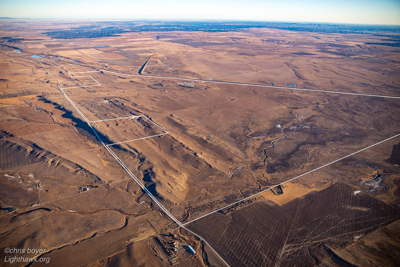
As proposals for new data centers crop up across the state, Montanans are seeking opportunities to weigh in on projects in the planning pipeline for companies such as Quantica and Atlas Power. Recent citizen ballot initiatives seeking voter approval before a developer can build a new data center reflect local residents’ desire for a voice in the future local data-center development.
Another iteration of that push for more information and input is unfolding before the Montana Public Service Commission, the elected utility board tasked with balancing the financial health of monopoly utilities with the interests of their customers who are unable to shop around for service from other providers.
In the 2.5 months since Montana’s largest electric utility, NorthWestern Energy, proposed a new rate structure designed specifically to serve large loads, nine entities have asked the PSC for approval to weigh in on that process. Montana Free Press reviewed those filings to help readers understand a piece of the power-supply puzzle critical to the future of data-center development in Montana.
WHAT EXACTLY IS NORTHWESTERN PROPOSING?
NorthWestern Energy has drafted one rate structure to calculate the monthly power bills of new customers that would require between 5 and 50 megawatts of electricity and another proposal for the rare new mega-users needing more than 50 megawatts of power. Data centers are the most obvious new customers NorthWestern is courting, but the guidelines would also apply to other companies with substantial needs for new or additional power, such as businesses in the industrial or manufacturing sector.
Under NorthWestern’s proposal, companies in the 5-50 megawatt category would be required to sign a five-year service agreement. If the new power user backs out before the contract term is up, it would be subject to a financial penalty. Other aspects of these agreements include a maximum load limit and a provision that would allow NorthWestern to prioritize other customers’ electricity needs in emergency situations where public safety is at risk.
Customers requiring more than 50 megawatts of power would be subject to a different, more tailored rate structure. The minimum contract length for those customers would increase to 15 years, and the agreement would include a provision specifying that their usage couldn’t fall below a certain level. Additionally, the PSC would be required to sign off on agreements NorthWestern drafts with these users before the utility could start supplying electricity to them.
NorthWestern maintains that these terms will prevent its existing customers, both residential and commercial, from picking up the tab for power plants, substations and transmission lines that the company builds to serve power-hungry new customers. NorthWestern, a shareholder-owned utility, also insists that it’s in the public’s best interest to facilitate data-center development to spur economic development, infrastructure investment and job creation.
“There is strong competition across the country to secure new data center customers for the benefits they provide not only to the utility, but also for other customers of the system and the communities in which the data centers are sited,” NorthWestern wrote in its filing. “Their high load factor supports grid stability and their contribution to revenue can help offset existing system fixed costs for all customers. They bring tax revenue to the state and local governments.”
WHO WANTS TO WEIGH IN ON NORTHWESTERN’S PROPOSAL AND WHY?
- The Montana Consumer Counsel. MCC is a small, constitutionally created state agency tasked with representing utility customers’ interests in matters before the PSC. Per Montana statute, MCC has broad latitude to engage in utility proceedings, so its filing contains scant detail as compared to the other parties that filed intervention requests.
- The Large Customer Group. Eight of NorthWestern’s largest existing industrial customers (think: refineries and mines) are included in this group. LCG argues that the new large load tariff will “directly and materially” affect its members. “The LCG’s members depend on receiving reasonably priced, reliable electric service in order to effectively operate, and expand, their businesses in Montana,” the group’s filing reads. “The LCG’s members, as existing NorthWestern customers and potential large load customers in the future, have a vested interest in ensuring any large load tariffs are fair and reasonable from the perspective of existing customers, prospective customers, and the utility.”
- A coalition of environmental and concerned-citizen groups. This coalition includes a suite of nonprofits distributed across multiple Montana communities. It wants to engage with the tariff to support “just and reasonable” rates for members. Some of the coalition’s members are eager to weigh in given the link between energy development and environmental issues. The groups incorporated in this petition include Montana Environmental Information Center, Big Sky 55-Plus, Climate Smart Missoula, and Butte Watchdogs for Social and Environmental Justice, among others. In a press release about the filing
- , the groups argue that transparency is critical to protecting NorthWestern Energy’s existing ratepayers.
- Montana Department of Environmental Quality. A state agency that oversees permitting and environmental regulations for power plants, oil refineries, coal mines, solar farms and large new transmission systems, DEQ described itself as the de facto state energy bureau in its filing. The agency’s director, Sonja Nowakoski, chairs the Energy Task Force that Gov. Greg Gianforte convened
- last September to increase the state’s electricity supply and facilitate the incorporation of large new industrial loads onto the grid. “No other party brings DEQ’s combination of statutory energy responsibilities and state-level energy planning expertise to this docket,” DEQ wrote in its filing.
- Northwest and Intermountain Power Producers Coalition. This group includes 22 players in the regional electricity generation and transmission industry. NextEra, an energy behemoth that operates a sprawling wind farm in eastern Montana, and Grid United, the company behind a $3.6 billion
- proposal aiming to connect the eastern and western grids, are intervening. Their concern? That NorthWestern Energy will assume some of their share of the “choice,” or market-based, customers they are currently serving. These businesses aim to ensure their share of the retail power market isn’t diminished and that they won’t be “unduly discriminated against.”
- Missoula County. In its filing, Missoula County argues that infrastructure costs, stranded assets, line strain and “retail rate leakage” could impact its utility bills. Since most of Missoula County is in the footprint of NorthWestern’s service territory, many of the county’s facilities are served by the energy company. The county also notes that it’s developing a Green Power Program in conjunction with the City of Missoula and NorthWestern Energy. The county has concerns about the future of power pricing for the 50-megawatt clean energy project it’s developing as part of that program.
- The City of Missoula. Montana’s second-largest city made claims similar to Missoula County. With 400 electricity and natural gas accounts served by NorthWestern and tens of thousands of Missoulians reliant on NorthWestern for electricity and/or natural gas service, Missoula’s local government wrote that electricity affordability is a key concern. It also argued that its constituents are impacted by the financial condition and “operational focus” of the utility. “The City’s expertise in local energy policy, municipal infrastructure and ratepayer impacts will contribute to the Commission’s full and fair consideration of the proposed [Large New Load] rule,” the city’s petition reads.
- Tony O’Donnell. A Billings resident and former member of the PSC, Tony O’Donnell filed the most unexpected motion of the bunch to intervene. In his filing, O’Donnell wrote that he has the background in “equal cost allocation and cost analysis distribution” to evaluate NorthWestern’s proposal. He added that he’s a NorthWestern customer himself. O’Donnell served eight years on the commission before he was termed out in 2023.
WHAT HAPPENS NEXT?
Both the PSC and NorthWestern Energy will review the intervention requests in the coming days. The final list of parties cleared to participate in the proceedings should come into focus by early July.
After that, the parties will start requesting and submitting financial and planning-related documents, and the PSC will schedule a hearing. At that hearing, NorthWestern will get a chance to make its case for its proposed tariff, and the other parties will have an opportunity to highlight why they think it is — or isn’t — in the commission’s best interest to approve the tariff. The document submission and hearings are part of a “quasijudicial” process that’s similar to the one the PSC oversees every few years when a monopoly utility wants to raise its electricity or natural gas rates.
Amanda Webster, the PSC’s chief lawyer, explained in an email to MTFP that the PSC will host a briefing after the hearing and a decision is anticipated within four months of that briefing. It’s possible, she said, that the 2027 commission will take up the matter. (Two seats on the commission, one currently held by termed-out commissioner Randy Pinocci, the other held by incumbent Annie Bukacek, will be decided by the November general election.)
Webster added that the PSC is likely to issue a decision on the proposed merger between NorthWestern and Black Hills Corp before the new tariff is settled.




(0) comments
Welcome to the discussion.
Log In
Keep it Clean. Please avoid obscene, vulgar, lewd, racist or sexually-oriented language.
PLEASE TURN OFF YOUR CAPS LOCK.
Don't Threaten. Threats of harming another person will not be tolerated.
Be Truthful. Don't knowingly lie about anyone or anything.
Be Nice. No racism, sexism or any sort of -ism that is degrading to another person.
Be Proactive. Use the 'Report' link on each comment to let us know of abusive posts.
Share with Us. We'd love to hear eyewitness accounts, the history behind an article.