
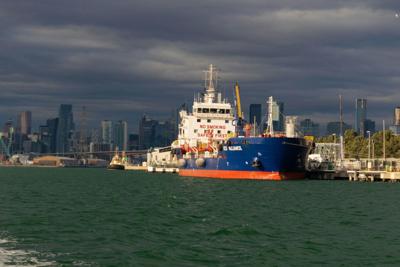

A barge collided with a column of the Pelican Island Causeway Bridge in Galveston, Texas on Wednesday, causing an oil spill and closing all access to the island.
According to the Associated Press, the incident occurred when a tugboat lost control of two large shipping vessels while exiting a nearby fuel storage facility, causing one of the barges to collide with the bridge. No injuries have been immediately reported, according to the AP.
David Flores, an official with the Galveston County Navigation District told the AP that a strong current and high tide caused the collision.
According to the AP, crews are working to clean up oil that ruptured from one of the damaged fuel barges. It remains unknown how much oil was released by the spill, according to a Facebook post from The City of Galveston. The collision also reportedly damaged an unused railway that runs along the bridge, causing it to topple onto the barge.
The damaged bridge is the only accessway to Pelican Island, which houses Texas A&M University of Galveston and a large shipyard, according to the AP.
According to the Facebook post, traffic along the bridge has been halted and will resume once the bridge has been properly inspected by the Texas Department of Transportation.
The accident comes just weeks after another cargo vessel collided with a pillar of the Francis Scott Key Bridge in Baltimore, resulting in 6 fatalities.
According to the AP, the Pelican Island Causeway Bridge was constructed in 1960 and received a poor rating from a 2023 report by the Federal Highway Administration.




(0) comments
Welcome to the discussion.
Log In
Keep it Clean. Please avoid obscene, vulgar, lewd, racist or sexually-oriented language.
PLEASE TURN OFF YOUR CAPS LOCK.
Don't Threaten. Threats of harming another person will not be tolerated.
Be Truthful. Don't knowingly lie about anyone or anything.
Be Nice. No racism, sexism or any sort of -ism that is degrading to another person.
Be Proactive. Use the 'Report' link on each comment to let us know of abusive posts.
Share with Us. We'd love to hear eyewitness accounts, the history behind an article.