


With the 24-hour media cycle saturating every moment of every day, it’s not hard to get overwhelmed by the news. It can make you want to pull a blanket over your head and say, “Look, I’ve got problems of my own. What can I do to really make a difference, anyway?”
Enter Earth Day. Observed every April 22 since 1970, it’s become the one day each year for people the world over to get back on the same page, with the health of the Earth in mind.
EarthDay.Org, the global organizer of the event, has named “Our Power, Our Planet” this year’s Earth Day theme. The group works with more than 150,000 partners in more than 192 countries to “drive positive action in the interest of the planet.” The goal behind this year’s theme is how "environmental progress doesn’t depend on any single administration or election. It’s sustained by daily actions of communities, educators, workers, and families protecting where they live and work." For individuals and businesses that want to help promote the event, EarthDay.Org is the place to go for logos, graphics, hashtags and other promotional content.
Chicago businesses and organizations across the area will be participating in a range of fun, educational and impactful events as a reminder to encourage governments, businesses and fellow citizens to use the rest of the year to make the Earth a healthier place for everyone.
Compost to your utmost
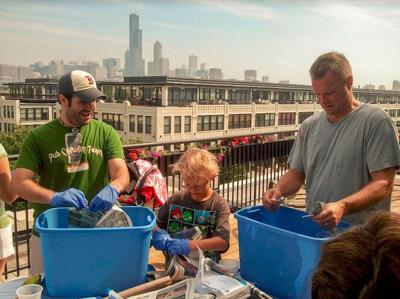
What is composting and why is it important? When organic waste, such as kitchen scraps, accumulate in landfills, it produces methane, one of the most potent greenhouse gasses. Composting diverts this waste from landfills and essentially turns it back into soil, so it can be used again. Depending on your consumer and eating habits, choosing to compost can reduce your environmental impact even more than recycling. And when you’re already separating trash for recycling, adding one more bin for compost is a snap.
Not sure where to begin? For those with yard space, residential composting can be as simple as tossing compostable material, such as table scraps and some paper products, into a bin. But a growing number of collection services and drop-off locations make composting convenient even for residents of Chicago’s most metropolitan areas, including apartment dwellers.
And when it’s time for planting or landscaping, the Metropolitan Water Reclamation District of Greater Chicago offers rich, “Exceptional Quality” compost for starting plants, or as mulch for established plants. Better yet they’ll deliver 10 yards or more of compost free to schools, non-profit organizations and residents. Smaller amounts can be picked up for free. The program opens again this spring. Check their website for details.
Visit IFSC online for comprehensive Illinois composting resources, including a list of compost collection services. Many of the farmers markets in Chicago also have compost drop-off locations which can be more economical than a weekly pick-up service.
Read more on Chicago Star
The city is blooming: Chicago's conservatories offer urban oasis
- Mom jokes: Comedians balance motherhood, insane schedules, comic relief
Pick a park, any park
The Chicago Park District and Friends of the Parks are great places to start to sign up or learn more about Chicago park and recreation area Earth Day events.
Go hard corps with the Chicago Conservation Corps
If you’d like to make a deeper commitment to the health of the environment (and you’re over 18), consider joining the Chicago Conservation Corps. A collaboration of the Chicago Academy of Sciences/Peggy Notebaert Nature Museum and other partners across the city, the group recruits, trains, and supports a network of volunteers who work together to improve the quality of life through environmental service projects in neighborhoods and schools across Chicago. To learn more, visit chicagoconservationcorps.org.
There are gaggles of home-grown city-sponsored environmental programs you may have never heard of, right here in town. Visit the city’s environment and sustainability page to learn about retrofitting commercial, residential and municipal buildings for increased energy efficiency; sustainable city transportation options; and eco-friendly strategies to manage the city’s natural areas.
Creating a green, sustainable Chicago requires hard work, cooperation and a commitment from local government, individuals and businesses. Stay in the loop by signing up for the monthly Chicago Sustainability E-Newsletter.
Originally published March 29, 2022




(0) comments
Welcome to the discussion.
Log In
Keep it Clean. Please avoid obscene, vulgar, lewd, racist or sexually-oriented language.
PLEASE TURN OFF YOUR CAPS LOCK.
Don't Threaten. Threats of harming another person will not be tolerated.
Be Truthful. Don't knowingly lie about anyone or anything.
Be Nice. No racism, sexism or any sort of -ism that is degrading to another person.
Be Proactive. Use the 'Report' link on each comment to let us know of abusive posts.
Share with Us. We'd love to hear eyewitness accounts, the history behind an article.