

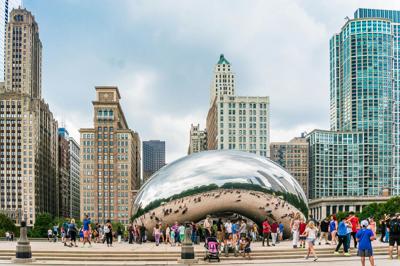
Walk into any bar on Wicker Park's Milwaukee Avenue on a Friday night, and you'll notice something: fewer people reaching for their wallets. The bartender taps a screen, a phone gets waved near a reader, and the transaction is done in seconds. Cash isn't gone from Chicago's nightlife, but it's fading fast, and the shift is happening across every corner of the city's entertainment space.
From the United Center to basement comedy clubs, venues are redesigning their payment infrastructure around digital-first experiences. Ticketing platforms like Eventbrite and AXS have moved almost entirely away from cash at the gate. Food-and-drink vendors inside major arenas rarely stock a cash drawer anymore. This isn't just convenience, it's a structural change in how Chicagoans spend when they go out.
Chicago venues ditching cash at record pace
The numbers tell a clear story. In-person card payments at bars and restaurants reached 25 per month per consumer in 2024, according to the Federal Reserve's 2025 Diary of Consumer Payment Choice. That milestone reflects a genuine behavioral change, not just a temporary blip driven by 2020’s hygiene concerns.
Chicago's transit system is moving in the same direction. The CTA's expanded digital fare infrastructure, funded through its FY2025 budget, is pushing riders toward tap-to-pay methods at every station. When the city's public transport system stops prioritizing cash, the message filters down to private venues too.
Why Chicagoans are embracing digital-only spending
Younger residents are leading the charge. The same Federal Reserve data shows that consumers aged 18–24 used cash for only 10% of all payments last year, compared to 19% for those aged 55 and older.
For a city with a dense population of young professionals and students, particularly in neighborhoods like Logan Square, Lincoln Park, and River North, that gap shapes how venues set up their payment systems.
Speed matters in a busy bar or theater. Digital payments cut transaction times, reduce errors, and eliminate the need to make change during peak hours. Venues aren't just following trends here; they're making a practical operational decision that also happens to align with what most of their customers already prefer.
Read more on Chicago Star
- NASA Standard Initiator that powered Artemis II named “Coolest Thing Made in Illinois”
- Get ready, players: Midwest Gaming Classic celebrates 25 years in Milwaukee with 10K games
- Pinkies up—it’s tea time! Chicago’s most luxurious hotels hosting spring afternoon tea
- Pokémon GO Fest returns to Grant Park for the game’s biggest annual event this summer
Anonymous digital payments are changing entertainment habits
The broader move toward contactless spending isn't limited to physical venues. That comfort extends online. The tech-savvy generation of today is accustomed to tapping their phone to pay. They are equally at ease exploring new no KYC casinos using cryptocurrencies like Bitcoin or Ethereum.
These platforms are built on the same idea of frictionless, ID-free digital spending that now defines how many people interact with entertainment generally. The behavioral thread connecting these experiences is the same: spend fast, spend privately, move on.
More than 60% of U.S. in-store transactions are projected to be contactless in 2025. Nearly 90% of consumers have used contactless methods at least once, according to Cheqly's US Contactless Payments report. That near-universal adoption has created a generation of spenders comfortable with quick, low-friction, often anonymous digital transactions.
What this means for Chicago's nightlife economy
The cashless switch brings genuine complications alongside the convenience. The 2025 Financial Health Pulse Chicago Trends Report notes that 33–35% of South and West Side residents remain financially vulnerable, with many more reliant on cash than the city's wealthier neighborhoods. Venues going fully cashless risk excluding residents who don't have reliable access to cards or digital wallets.
Chicago's entertainment economy thrives on inclusivity, the dive bar, the neighborhood theater, and the street food vendor. As the industry moves faster toward digital-only payments, the challenge isn't technical.
It's making sure that speed and convenience don't quietly redraw the lines of who gets to participate in the city's cultural life. That tension will define the next phase of this transition more than any payment app or contactless terminal ever could.




(0) comments
Welcome to the discussion.
Log In
Keep it Clean. Please avoid obscene, vulgar, lewd, racist or sexually-oriented language.
PLEASE TURN OFF YOUR CAPS LOCK.
Don't Threaten. Threats of harming another person will not be tolerated.
Be Truthful. Don't knowingly lie about anyone or anything.
Be Nice. No racism, sexism or any sort of -ism that is degrading to another person.
Be Proactive. Use the 'Report' link on each comment to let us know of abusive posts.
Share with Us. We'd love to hear eyewitness accounts, the history behind an article.